
Singer-Songwriter Nights in Denver: Formats, Etiquette and How to Find Your Room

Denver has several kinds of songwriter nights, and they feel very different. Some are quiet listening shows where original songs are the whole point. Others are open mics where you sign up and play three songs. Some are showcases where a booked lineup trades songs. Once you know which one you are walking into, picking a night gets easy, whether you want to hear new writing or take the stage yourself. Below we walk through the formats, one well-documented Denver example, etiquette, and how to confirm a night is really happening before you head out.
TL;DR
- A songwriter night is usually a listening room built around original songs. An open mic is a sign-up stage. A showcase is a booked lineup. Check which one you are attending.
- One documented example: Songwriters at the Speakeasy, 7 to 9 p.m. on the second and third Tuesdays of each month at 554 S. Broadway.
- Expect quiet rooms, short sets of originals, and tips for the artists. Talking during songs is discouraged.
- Always confirm the current schedule with the host or venue before you go. Recurring nights move, pause and change formats.
- You can browse local songwriter listings on our singer-songwriter events page for Denver.
Table of Contents
- 🎶 What counts as a singer-songwriter night?
- 🔎 A Denver example: Songwriters at the Speakeasy
- 🎤 How to find singer-songwriter nights in Denver
- 🤝 If you want to perform
- 🎧 If you are going to listen
- 💬 What about cost, age limits and reservations?
- ✅ How to confirm a night is still on
- 🎟️ Find your next night on Experience By Locals
- A simple plan for your first songwriter night
- FAQ
- Sources
🎶 What counts as a singer-songwriter night?
The phrase gets used loosely, so it helps to sort the formats. Here are the three you will meet most often in Denver.
| Format | How it works | Best for |
|---|---|---|
| Songwriter night (listening show) | Invited songwriters play originals, often trading turns with the hosts. The room is quiet and attentive. | Audiences who want to hear the song and the story behind it |
| Open mic | Performers sign up, usually for a short slot, and the order is set by the host. | Players trying new material or testing a first live set |
| Showcase | A booked lineup, sometimes themed by genre or a record release. | Fans looking for a curated evening and artists seeking exposure |
The lines blur. Some hosts run a songwriter-focused open mic. Some listening shows pull in a few guests from the audience. That is why the label on a flyer is worth reading closely, and why a quick message to the host pays off.
Why the difference matters
If you are a listener, a listening show gives you a very different night than a loud bar open mic. People come for the songs in their stripped-down form, with a guitar or piano and a voice, and not much else. If you are a performer, a listening room asks for your best original material, not covers, and it rewards a tight, well-chosen set.
🔎 A Denver example: Songwriters at the Speakeasy
One of the best-documented songwriter nights in town is Songwriters at the Speakeasy. According to a Thirst Colorado write-up from 2026, it runs from 7 to 9 p.m. on the second and third Tuesdays of each month at 554 S. Broadway in Denver.
The format is a good model for what a songwriter night can be:
- Guest songwriters perform originals, alternating with the hosts.
- Each guest plays about five original songs.
- Audience members may be drawn to perform, with names pulled from a hat, but it is not an open mic.
- Tips for the artists are appreciated, and talking during songs is discouraged.
The host describes it as a listening show, a place where people come to hear songs quietly and as they were first written. That sums up the spirit of a good songwriter night. If you want to read more about how artists approach getting booked into rooms like this, this guide on how to book shows as a music artist walks through the basics from the performer's side.
Why a twice-monthly rhythm works
A night that repeats on the same weekdays builds a regular crowd. Guests know when to show up, songwriters can plan around it, and the room gets a feel of its own. When you are hunting for a place to become a regular, look for exactly this pattern: a fixed weekday or week of the month, a clear format, and a host who is easy to reach.

🎤 How to find singer-songwriter nights in Denver
No single list captures everything, because many of these nights are small, host-run and easy to miss. A mix of approaches works best.
- Start with a curated listing. Our Denver singer-songwriter events page gathers shows hosted by local artists, and our acoustic events in Denver page is a good next stop if you prefer unplugged evenings.
- Look at showcases. If you like seeing several acts in one evening, browse the Denver music showcases.
- Widen to all live music. Our live music in Denver page shows what else is on the same week, which helps when your first choice falls through.
- Learn the neighborhoods. Different parts of town lean toward different rooms. Our neighborhood-by-neighborhood guide to indie music venues in Denver helps you match a night to an area you already like.
- Follow the hosts. Many songwriter nights live on a host's social page or newsletter. If you enjoy one, follow the person, not just the place.
- Ask at the show. The best tip for your next night usually comes from the person next to you.
Browse by what you want from the night
- Quiet and attentive: look for the words listening room, songwriter round, or in the round.
- Social and casual: look for open mic, jam or meetup.
- Curated and polished: look for showcase, release show or featured artist.
The same words appear in event descriptions, so they work as quick filters even outside our site.
🤝 If you want to perform
Most songwriters play their first Denver rooms by showing up as a listener. Spend one or two evenings watching how a night runs, then talk to the host. Here is a simple path.
Step 1: Match your material to the format
A listening show wants original songs, and the Speakeasy model above is built around about five of them per guest. An open mic usually wants fewer. Have a short set and a longer set ready, so you can say yes to either.

Step 2: Ask the host directly
Every night handles sign-up differently. Some use a list at the door, some pick names, some book guests ahead of time. At Songwriters at the Speakeasy, for example, audience members may be selected by drawing names from a hat, so there is no list to join in advance. Ask these questions before you go:
- How do performers get on the bill?
- How long is a slot, and how many songs does that mean?
- Do I bring my own instrument, and is there a house keyboard or direct input for acoustic guitar?
- Is it all originals, or are covers welcome?
- Is there a sound check, or do I plug in and start?
Step 3: Prepare a tight, memorable set
Short sets reward clarity. Open with something that shows who you are. Put your strongest story song in the middle. Leave a beat of quiet after the last chord. Keep spoken intros short: one line about a song can pull a room in, while three minutes of tuning talk can lose it.
Step 4: Be a good guest
Watch the other performers, put your phone away, and say thank you to the host. Hosts remember the people who stayed. Tips, where they are collected, are a way of saying the music mattered to you, and the practice is appreciated at the Speakeasy night.
Step 5: Keep going
One set rarely changes much. Showing up for a month of recurring nights does. You will meet the other writers, learn who plays what, and hear about the next room before it is posted anywhere. If you want to turn that momentum into paid shows, our Denver hip hop open mic guide covers how to find a stage and avoid a wasted trip, and much of its advice carries over to any genre.
🎧 If you are going to listen
You do not need to know a single songwriter to enjoy these nights. Some things make them better.
- Arrive a little early. Small rooms fill, and seats near the performers go first.
- Treat the room as a listening room. At the Speakeasy, talking during songs is discouraged, and that is a safe default almost anywhere songs are the point.
- Bring cash or a way to tip. Songwriters often rely on it.
- Stay for the stories. Between songs, writers often share where a lyric came from. That is the heart of the format.
- Go with a friend. Quiet rooms are better shared, and you will have someone to compare favorite songs with on the walk home.
If you like to browse music venues and the shops where the local scene hangs out, the record stores in Denver are a natural stop on the way to an evening show, and often a good place to spot flyers for songwriter nights.
💬 What about cost, age limits and reservations?
These details change from room to room and season to season, so we will not guess. Some nights are free with tips for the artists, some ask for a cover, and some venues set age rules based on their bar or kitchen. The reliable method is simple:
- Read the event description for a cover, ticket link or age notice.
- Check the venue's own page or the host's latest post for reservation details.
- If it is unclear, send a short message and ask. Hosts are usually glad to hear from someone planning to come.
When a show is ticketed through our platform, the event page shows what the host has set for booking.
✅ How to confirm a night is still on
Recurring nights are easy to find and just as easy to find outdated. A flyer from years ago can sit at the top of a search page long after a series has ended. Before you drive across town:
- Check the date on the page. If the latest post is old, treat it as unverified.
- Look for a pattern. Phrases like second and third Tuesdays give you a schedule to count against the calendar, but holiday weeks and venue events can shift things.
- Go to the source. The host's or venue's own page is the most current.
- Message and wait for a reply. A short note the day before saves a wasted trip.
- Have a backup. Pick a second room nearby, or browse live performances in Denver for something else on the same night.
Our take: why songwriter nights are worth protecting
We built Experience By Locals because the best nights in Colorado are often the ones that never make a tourist brochure: a songwriter in a small room, a host who knows everyone's name, an audience that actually listens.
Those nights run on people showing up. We believe a good listing does two jobs. It helps a curious guest find a room that fits them, and it helps a local artist be found without needing a big marketing budget. That is why our focus is local talent, hosted by the community.
If you are a songwriter, we hope you will list your night and let guests book straight with you. If you are a listener, we hope you will try one new room this month and bring a friend. Small rooms stay open when people fill them.
DJ
🎟️ Find your next night on Experience By Locals
Ready to hear original songs from Denver artists? Explore the live music, comedy, dance and theater lineup in Denver, filter by what you like, and book directly with the hosts.
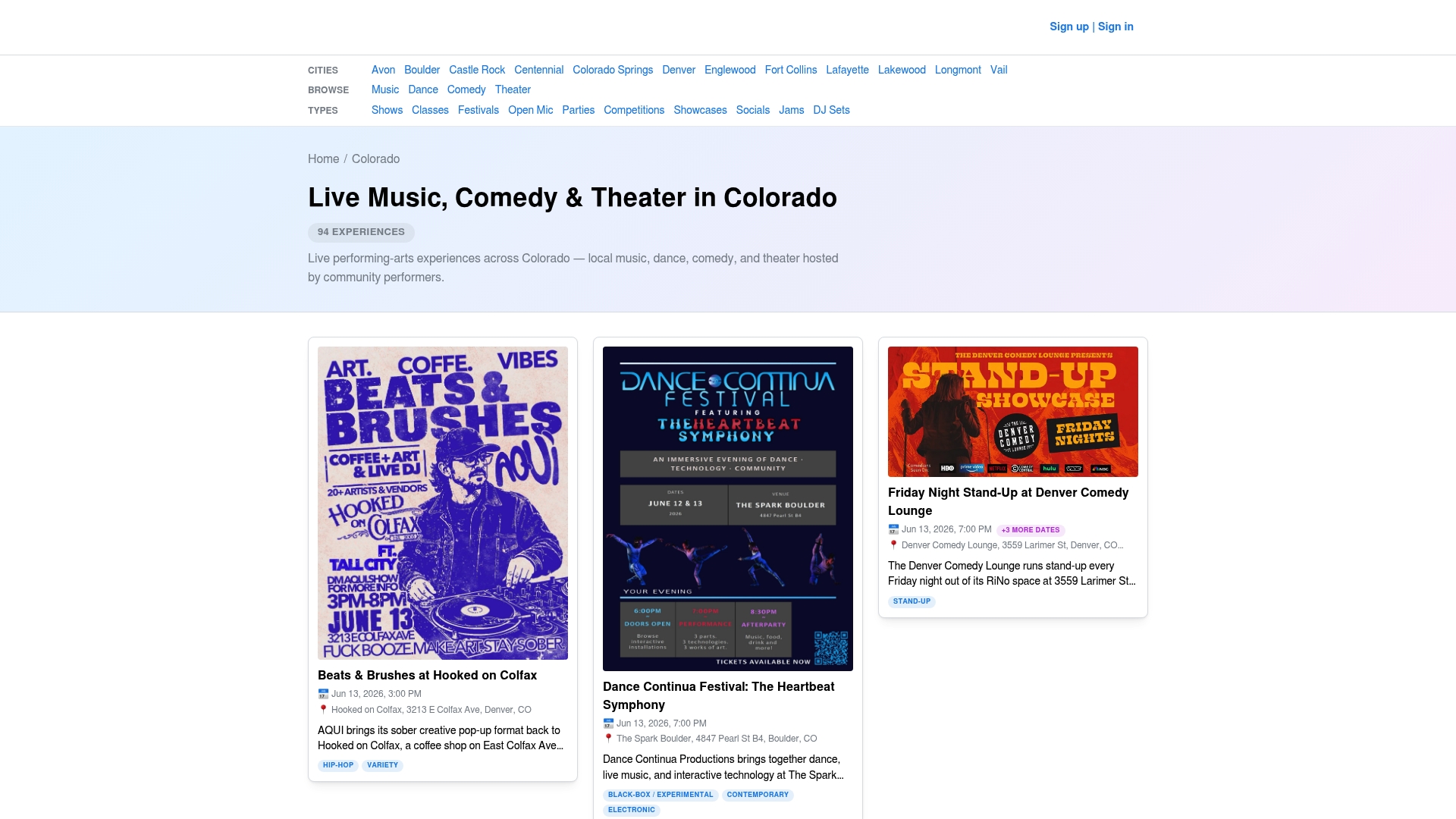
Performers and hosts are welcome too. Start from our Colorado home page to see how listings work, and take a look at live music across Colorado if you are planning a trip beyond Denver.
A simple plan for your first songwriter night
If you want a no-stress way to start, try this over the next few weeks.
- Week one: pick a listening show or songwriter round and go as a guest. Sit near the front, stay for the whole night, and note what makes it work.
- Week two: try a different format, such as an open mic or a showcase, so you can compare the feel.
- Week three: introduce yourself to a host. Ask about their format and how they choose performers.
- Week four: go back to your favorite room. Familiar faces are what turn a night into a community.
That rhythm works whether you are a listener who wants a regular spot or a writer building toward a first set. Along the way, keep a short note of the songs and artists you liked. It makes the next recommendation conversation much easier, and it is a lovely record of a year of local music.
FAQ
Is a songwriter night the same as an open mic?
Not usually. A songwriter night is typically a listening show built around original songs, often with guest writers and hosts trading turns. An open mic is a sign-up stage for short slots. Some nights mix both, so read the description or ask the host.
How many songs do you play at a songwriter night?
It depends on the night. At Songwriters at the Speakeasy, guest songwriters play about five originals, according to local reporting. Open mics are often shorter. Ask the host before you go and prepare one shorter and one longer set.
Do I need to bring my own instrument?
Usually yes, especially a guitar. Many rooms have basic sound equipment, but not always a keyboard or house instruments. Ask the host what is provided, including whether you can plug in directly, so you are not surprised on the night.
How do I know a Denver songwriter night is still running?
Check the host's or venue's own page for a recent post, compare the stated schedule with the calendar, and send a short message if anything is unclear. Old listings linger online, so a quick confirmation saves you a trip.
Can tourists go to these nights?
Absolutely. Songwriter nights are a great way to hear the city through its own writers. Browse our Denver listings to find a night that fits your dates, and confirm details with the host before you go.
Sources
- Songwriters at the Speakeasy tunes up Broadway twice a month (Thirst Colorado)
- How to Book Shows as a Music Artist
- Record stores in Denver, CO