
Two Denver Arts Districts That Actually Host Artist Run Shows

RiNo Art District and Art District on Santa Fe are the two arts districts to put on your list first, and for good reason: between them you experience Denver's dense mural corridor, its popular First Friday gallery walk, and many working studios. Book a guided street-art tour for RiNo, then plan a Friday evening for the Santa Fe gallery crawl, and you've covered the heart of Denver's creative scene in one weekend.
TL;DR:
- RiNo's murals are densely concentrated along Larimer, Brighton, and Walnut streets, with the district's mural festival, CRUSH Walls, repainting sections annually.
- Santa Fe's First Friday gallery crawl involves participating galleries opening around 5 or 6 p.m., creating a lively, community-focused event that supports its Creative District status.
- Guided tours and artist interviews provide deeper context than self-guided walks, especially highlighting neighborhood history and artist intentions.
- Parking is limited during weekends and festivals; public transit and rideshare are recommended, especially for RiNo's industrial blocks.
- Lesser-known artist-run shows, workshops, and pop-ups often escape large event listings, making grassroots experiences essential for authentic neighborhood engagement.
Table of Contents
- Comparing Denver's Top Arts Districts and Creative Anchors
- What to See in RiNo: Murals, Public Art, and Signature Spots
- What to See on Santa Fe: Galleries, Studios, and Co-ops
- Tours, Classes, and Live Events: Choosing the Right Experience
- Practical Planning: Timing, Transit, Parking, and Access
- How Local Expertise Surfaces the Shows Tourists Miss
- How Denver's Arts Districts Took Shape
- Why These Neighborhoods Matter Beyond the Murals
- What's Next for Denver's Arts Districts
- A Local's Quick Itinerary and Offbeat Tips
- A Different Way to Find Denver's Smaller Artist-Hosted Shows
- FAQ
- Sources
Comparing Denver's Top Arts Districts and Creative Anchors
Each district and organization below plays a different role in Denver's creative scene, so the right first stop depends on what pulls you in: color and murals, quiet gallery browsing, or getting to know working artists.
- RiNo Art District and RiNo Art Park cover the mural-heavy, festival-driven side of Denver, best for a high-energy weekend walk among breweries, converted warehouses, and wall-sized art.
- Art District on Santa Fe anchors the gallery-and-studio side of town, where First Friday turns a quiet strip into a packed, friendly crawl.
- Plinth Gallery is the spot for ceramics and sculptural work, while Artists on Santa Fe Gallery and Studios and D'art Gallery Denver showcase cooperative, artist-run curation.
- RedLine Contemporary Art Center and Denver Art Society lead on nonprofit and community programming, including residencies and low-cost access for local creators.
| District or organization | Google rating | Best for | Standout |
|---|---|---|---|
| RiNo Art District | 4.6★ (556 reviews) | Murals, street art, high-energy weekend visits | Largest mural density and festival programming |
| RedLine Contemporary Art Center | 4.7★ (361 reviews) | Contemporary programming, artist residencies | Artist-in-residence and community engagement |
| Art District on Santa Fe | 4.6★ (188 reviews) | Gallery crawls, artist studios | Monthly First Friday and deep gallery network |
| RiNo Art Park | 4.4★ (109 reviews) | Community events, markets, family visits | Public park and studio campus |
| Denver Art Society | 4.8★ (95 reviews) | Participatory art, artist-community programs | Low-cost access and diverse programming |
| Artists on Santa Fe Gallery and Studios | 4.8★ (48 reviews) | Cooperative gallery shows | Historic cooperative studio model |
| D'art Gallery Denver | 4.9★ (33 reviews) | Rotating contemporary shows | Co-op curation |
| Alto Gallery | 4.8★ (25 reviews) | Small-venue exhibitions and talks | Workshop and artist-talk programming |
| Plinth Gallery | 4.8★ (16 reviews) | Ceramics and sculptural work | Ceramics specialization |
| PlatteForum | 4.5★ (8 reviews) | Artist-led public programming | Nonprofit exhibition-making |
| Golden Triangle Creative District | 5★ (7 reviews) | Institutional arts programming | Creative-district coordination |
Ratings reflect Google Places listings and change over time, so treat them as a general pulse rather than a fixed ranking.
What to See in RiNo: Murals, Public Art, and Signature Spots
Walking RiNo without a plan means missing half of it. The mural corridors along Larimer, Brighton, and Walnut streets hold the densest concentration of outdoor art in the city, and River North Art District grew directly out of an industrial neighborhood that artists and small manufacturers reclaimed one warehouse at a time. That transformation is still visible in the converted loading docks and brick facades now covered floor to roofline in color.
Start or end your walk at RiNo Art Park, home to the Truss House and a rotating lineup of markets and pop-up shows. A few things worth building into your route:
- Larimer, Brighton, and Walnut streets hold the thickest mural concentration and the easiest walking loop.
- RiNo ArtPark and Truss House anchor community events, so check their calendar before you go.
- CRUSH Walls, the district's annual mural festival, repaints large sections of the neighborhood each year, so a wall you loved last fall may be gone by spring.
Murals here are not static museum pieces. They get painted over, reworked, or replaced as CRUSH Walls brings in new artists, which is part of what keeps the district feeling alive rather than frozen.
Pro Tip: Credit the artist, not just the wall, when you post photos. Most murals have a signature or tag in the corner, and tagging the right name online supports the person who actually made the work.
What to See on Santa Fe: Galleries, Studios, and Co-ops
First Friday on Santa Fe Drive runs on a rhythm locals have down to a science: doors open around 5 or 6 p.m., galleries pour wine, and the crowd moves block by block until well past dark. It's the reason Art District on Santa Fe earned its status as a state-certified Creative District, one of a small number in Colorado recognized for sustained, organized arts activity.
A few stops worth building your evening around:
- Artists on Santa Fe Gallery and Studios houses 15 juried artists and 25 resident studio artists, with monthly gatherings and First Friday exhibitions that let you talk directly to the people whose work is on the walls.
- D'art Gallery Denver is a cooperative space with rotating shows, so the lineup genuinely changes month to month rather than running the same inventory.
- Alto Gallery pairs exhibitions with workshops and artist talks, a good pick if you want more than a quick browse.
- Plinth Gallery is the city's clearest destination for ceramic and sculptural work, with curated shows built around that one discipline.
Outside First Friday, most Santa Fe galleries keep shorter weekday hours, so check individual listings before a weekday visit.
Tours, Classes, and Live Events: Choosing the Right Experience
A guided street-art tour gets you context: who painted a wall, what neighborhood history it references, and why a particular corner matters. Self-guided walking covers more ground on your own schedule but leaves those stories untold unless you happen to run into the artist. Local guides who interview working artists tend to surface details, like a mural's connection to a neighborhood's history or a resilience theme, that you would not pick up just looking at a wall.
Beyond murals, the range of experiences worth stacking into a visit includes:
- Guided mural tours for context and storytelling you can't get from a self-guided walk.
- Gallery talks and artist receptions, common at Alto Gallery and Artists on Santa Fe, for direct conversation with makers.
- Ceramics workshops, a Plinth Gallery specialty, for hands-on learning.
- Intimate music and theater shows hosted in small venues around both districts, which often sell out faster than larger events.
Book tours and workshops a few days ahead when possible, and check individual venues for ADA access since many RiNo and Santa Fe buildings are converted warehouses with uneven entry points.
Practical Planning: Timing, Transit, Parking, and Access
Weekday mornings and early afternoons give you the quietest mural viewing in RiNo, with good light and no crowds to dodge for photos. First Fridays and festival weekends, especially during CRUSH Walls, bring the opposite: packed sidewalks, slow-moving crowds, and a much livelier but more congested experience.
For getting around:
- RTD's A Line and local bus routes reach both districts, and a day pass often beats hunting for street parking.
- Rideshare drop-off works well for RiNo's warehouse blocks, where parking lots fill fast on weekends.
- Combine RiNo and Santa Fe in one day only if you're comfortable with a short drive or rideshare between them, since they sit on opposite sides of downtown.
RiNo's own organization notes the district built its identity on dense, walkable blocks of converted industrial space, which is exactly why parking gets tight during peak hours. Most galleries and studios welcome visitors, but treat working studio spaces with the same courtesy as someone's workshop: ask before touching materials, and keep an eye on kids near active work areas.
How Local Expertise Surfaces the Shows Tourists Miss
Larger event calendars tend to surface the same handful of big murals and headline galleries. The smaller, artist-run shows, pop-ups, and workshops that give a district its texture often live off that radar entirely.
- We list grassroots events, workshops, and small performances hosted directly by local artists, the kind that rarely make it onto bigger tourist calendars.
- Guided tours and artist-interview-based experiences consistently add context that self-guided viewing alone does not provide.
- Prioritizing artist-run shows and pop-ups over the most-advertised stops tends to reward you with a more genuine, less commercial version of the neighborhood.
How Denver's Arts Districts Took Shape
RiNo's story starts with warehouses and light manufacturing, not galleries. Artists moved into cheap industrial space along the river in the 1990s and 2000s, and what began as affordable studio space slowly turned into a formally organized creative district with its own nonprofit coordination, festivals, and now a packed calendar of murals and events.
Santa Fe Drive followed a different path. The corridor built its identity around a cluster of galleries and studios that banded together for mutual visibility, eventually earning formal recognition as one of Colorado's state-certified Creative Districts. That certification matters because it signals sustained, organized arts activity rather than a handful of unrelated storefronts, and it helped cement First Friday as a monthly fixture rather than an occasional event.

Both paths point to the same underlying pattern: Denver's arts districts grew from artists claiming underused space, not from top-down planning. RedLine Contemporary Art Center's residency model and Denver Art Society's low-cost community access extended that same logic into nonprofit programming, giving working artists room to create and show work through participatory art programs without the overhead of a commercial gallery. The result is a creative map built block by block, mostly by the people making the work, which is part of why these neighborhoods still feel distinct from more polished, developer-driven arts precincts elsewhere.
Why These Neighborhoods Matter Beyond the Murals
A thriving arts district does more than give visitors something to photograph. Galleries, studios, breweries, and restaurants cluster together in both RiNo and on Santa Fe Drive, and that density draws foot traffic that supports small businesses on both sides of the counter, from the gallery owner to the coffee shop next door.
Festivals like CRUSH Walls bring an annual spike in visitors specifically to see new murals, which keeps RiNo's walls in constant rotation and gives working artists paid, high-visibility commissions rather than unpaid wall space. On Santa Fe, First Friday does the same work on a monthly scale, turning gallery openings into a recurring reason for people to spend an evening, and a few dollars, in the neighborhood.
The cultural impact runs deeper than the economic one. Observers who study arts districts generally agree that authenticity depends on retaining actual studio space and artist-run programming, not just commissioning murals for visitors to photograph. RedLine's residencies and Denver Art Society's open-access model are part of what keeps that balance intact, giving artists somewhere to make work year-round instead of showing up only for festival season. Lose that working studio space to rising rents, and a district risks becoming a backdrop rather than a living creative neighborhood, which is the tension both RiNo and Santa Fe continue to manage as they grow.

What's Next for Denver's Arts Districts
Both major districts keep evolving rather than sitting still. RiNo Art Park continues adding programming around the Truss House, with markets, pop-up shows, and community events layered onto the original studio campus, giving the district a public gathering space to go with its murals. Expect that kind of incremental expansion, more programmed space rather than a single big build, to continue as the district matures.
Santa Fe's certified Creative District status gives it a formal structure for coordinating growth, which generally means steady investment in gallery and studio infrastructure rather than sudden change. Smaller organizations like PlatteForum and Golden Triangle Creative District point to a broader pattern across Denver: nonprofit and institutional groups are playing a bigger role in coordinating exhibitions and neighborhood-level programming, which tends to stabilize a district's identity even as individual galleries open and close.
The throughline across both neighborhoods is pressure to preserve working studio space as real estate values climb. How well RiNo and Santa Fe manage that tension will likely decide whether they keep their artist-driven character or gradually shift toward a more commercial, visitor-first model over the next several years.
A Local's Quick Itinerary and Offbeat Tips
For a half day, walk RiNo's Larimer and Brighton murals in the morning, then catch a Santa Fe gallery opening that evening. For a full day, add a ceramics workshop or an intimate local show between the two. Watch artist social feeds for pop-ups, and buy a small piece or attend a talk. Direct support means more to a working artist than a photo ever will.
— DJ
A Different Way to Find Denver's Smaller Artist-Hosted Shows
Galleries and districts cover the big openings well, but the smaller artist-hosted shows, workshops, and intimate performances around RiNo and Santa Fe often never make it onto a printed gallery schedule. That's exactly the gap we built our platform to close.
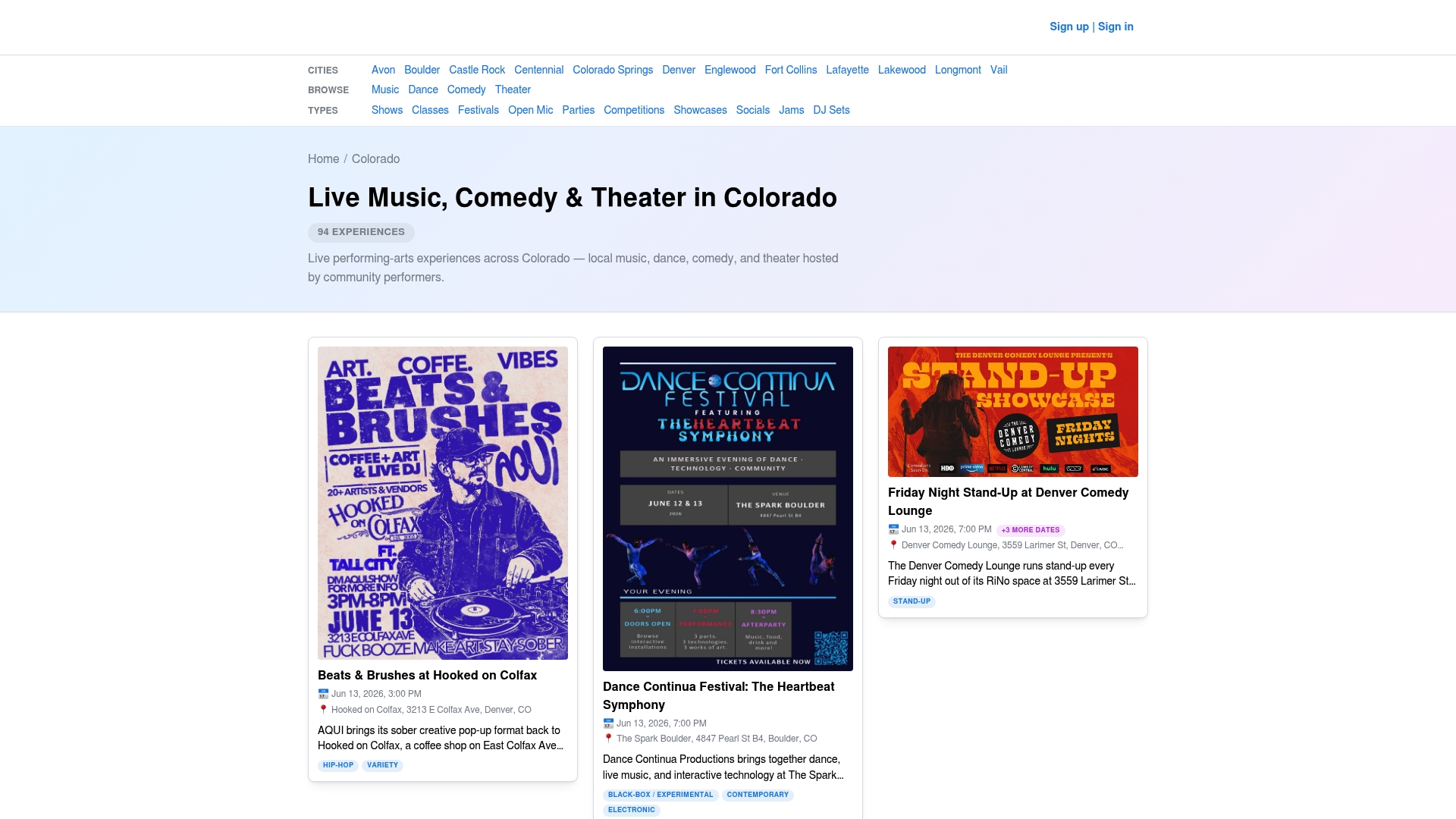
- We list local music, comedy, dance, and theater events hosted directly by artists and creators, not venue-programmed filler.
- Use us when you want a small-group experience with real access to the performer or artist, not large-scale productions.
- Our Colorado events landing page lets you browse music, dance, comedy, and theater by date and neighborhood.
If your Santa Fe or RiNo day leaves you wanting a smaller, artist-hosted show to close it out, browse what's listed near Denver and book directly with the people putting it on.
FAQ
What are some artsy neighborhoods in Denver?
RiNo Art District and Art District on Santa Fe are Denver's two best-known arts neighborhoods, covering mural-heavy streets and gallery-and-studio corridors respectively. Denver's Golden Triangle, home to the Golden Triangle Creative District, adds a third option focused on institutional arts programming.
What is the most artsy town near Denver?
Paonia, in Colorado's North Fork Valley, is often mentioned as a small-town arts community near Denver that draws painters, sculptors, and writers seeking a quieter creative setting. It's a multi-hour drive rather than a day trip, so it suits travelers planning a longer Colorado itinerary.
What is the 70/30 rule in art?
Definitions of the so-called rule vary depending on the context, whether composition, color theory, or gallery business practice, and none of the Denver sources we drew on define a canonical version. If you've seen it referenced for a specific gallery or technique, it's worth asking that source directly what they mean.
What is Denver's gayborhood?
Denver's most commonly cited LGBTQ+ neighborhood is Capitol Hill, particularly along Colfax Avenue, known for its bars, shops, and community events. It sits close to both the Golden Triangle and Santa Fe arts districts, making it easy to combine with a gallery walk.