
Neighborhood Playbook: Meetup Alternatives With Experiencebylocals
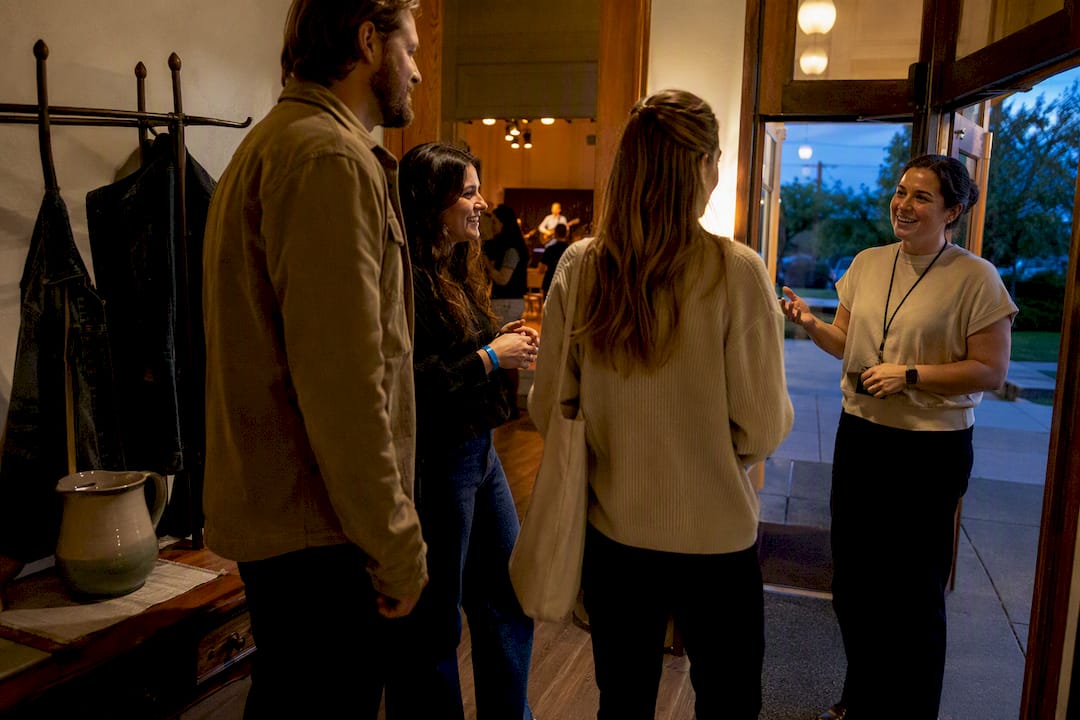
Here, "meetup alternatives" means searchable marketplaces and neighborhood channels for authentic live performances, not group organizing apps. If you want real local music, comedy, dance, or theater, skip the algorithm-driven event feeds and go straight to a marketplace built around local artists, like Experiencebylocals, or your nearest resident-focused venue and community group. That's the fastest route to a show that actually reflects your city instead of its tourist map.
TL;DR:
- Local event marketplaces like Experiencebylocals and neighborhood social pages are more effective than apps for discovering authentic performances by community artists.
- Venue types such as house concerts, community halls, and galleries typically host recurring, artist-focused events with modest prices and community-driven promotion.
- Verifying event legitimacy involves checking for a named organizer, recent social proof, clear refund policies, and accessible venue details, with red flags indicated by multiple warning signs.
- Budget around $10 to $25 for tickets, tips, and merchandise at local shows, which are significantly cheaper than large-venue concerts and offer better value.
- Building a community relies on frequent attendance, engaging with artists on social media, volunteering, and prioritizing recurring nights and local partnerships over one-off events.
Table of Contents
- What Counts as a Real Meetup Alternative for Live Shows?
- Which Venues Actually Host Authentic Local Performances?
- How Do You Verify an Event Before Buying Tickets?
- How Should Artists List and Promote a Show?
- What Makes a Local Scene or Small Festival Actually Last?
- Staying Safe and Fitting in at a Local Show
- How Do You Meet People and Build Community at These Shows?
- What Should You Budget for Authentic Local Shows?
- DJ's Take: What Actually Works
- Find or List a Show With Experiencebylocals
- Sources
- FAQ
What Counts as a Real Meetup Alternative for Live Shows?
A meetup alternative, in this sense, is any channel that connects you directly to local artists and the people who book them rather than a generic group calendar. That includes searchable event marketplaces, neighborhood social pages, and old-fashioned community bulletin boards. The goal is the same everywhere: find shows programmed by and for the people who actually live there.
Online channels worth checking first:
- Location tags on Instagram and TikTok tied to specific venues or neighborhoods, not just city names.
- Local subreddits and city-specific forums, where regulars post about open mics and pop-up shows.
- Private coordination spaces like Discord servers, WhatsApp threads, and Telegram groups, which double as booking and promo-swap hubs for grassroots scenes.
- Hyperlocal event apps that filter by walking distance rather than metro area.
Offline channels that still outperform apps:
- Posters at indie bookstores, coffee shops, and record stores, since many open mics and small shows never make it onto major ticketing platforms at all.
- Community bulletin boards at coffee shops, laundromats, and college student centers.
- Arts councils, neighborhood associations, and genre-specific societies, which often run steady calendars you won't find through search.
Five quick signs an event is resident-focused rather than tourist-first: the venue has no big-brand signage, ticket prices are modest, the lineup changes regularly, promotion happens mostly through word of mouth, and the organizer's name (not a corporate account) appears on the listing.
Pro Tip: Search Instagram by neighborhood tag plus "open mic" or "showcase" instead of the venue's official handle. Artists tag their own neighborhoods long before venues update their bios.
Which Venues Actually Host Authentic Local Performances?
Not every stage is created equal, and the venue type tells you a lot about what to expect before you even buy a ticket. Some spaces exist specifically to platform community talent; others just happen to have a stage.
- House concerts and living-room shows: Intimate, often 15 to 40 people, usually run on suggested donations or pass-the-hat pricing.
- Community halls and VFW/union halls: Larger capacity, modest ticket prices, frequently rented by local promoters rather than booking agencies.
- Coffee shops and independent cafes: Regular open mic nights, low cover charges, casual atmosphere geared toward local regulars.
- Galleries and artist-run spaces: Genre-crossing shows (music paired with visual art or dance), often the source of unusual bills you won't see elsewhere.
- Pop-ups in unconventional spaces: Warehouses, backyards, or retail spaces borrowed for a single night, usually the most local and least polished option.
The reliable signal across all of them is a recurring night. A venue that hosts the same night weekly or monthly, with a consistent local curator picking acts, tends to pay artists more fairly and price tickets more modestly than a one-off booked through a national platform. Capacity and vibe shift by venue type, but the ticketing model at genuinely local shows almost always stays simple: cash at the door, a suggested donation, or a low-fee online link, not a tiered dynamic-pricing system.
How Do You Verify an Event Before Buying Tickets?
Verification takes about five minutes and saves you from showing up to a canceled show or an inflated resale listing. Run through this before you commit:
- Check for a named organizer. A real person or small local business listed, not just a generic account name.
- Read the refund policy. Legitimate small organizers usually state one plainly, even if it's simple.
- Look at the ticket fees. Fees above 15 to 20% of face value often signal a middleman reseller rather than the original event page.
- Confirm venue contact details. A working phone number or address that matches the listed neighborhood.
- Cross-check social proof. Recent photos from past events, artist tags that match the announced lineup, and consistent details across two or more channels.
- Verify accessibility basics. Capacity limits, parking or transit notes, and ADA information, especially for smaller or converted spaces.
If a listing fails two or more of these checks, treat it as a red flag rather than a maybe.
Pro Tip: Message the organizer directly before buying if the event is new to you. A real local promoter almost always answers within a day; a reseller account usually doesn't answer at all.
How Should Artists List and Promote a Show?
Getting booked is only half the job. Getting people in the door requires a listing that does the selling for you and a promotion plan that doesn't rely on luck.
Listing essentials:
- Real photos or video from a past performance, not stock images.
- A short bio that names your genre or style plainly, plus any collaborators.
- Clear ticket tiers (general admission, VIP add-on, group rate) so buyers know exactly what they're getting.
- Venue tech specs and accessibility notes, so attendees and other performers know what to expect.
Promotion tactics that outperform generic posting:
- Partner with a genre society or arts council for co-promotion, since affiliate networks like Folk Alliance International already reach an audience primed for live shows.
- Tap your own artist network for cross-promotion swaps instead of paying for ads.
- Use neighborhood tags on social posts, and don't skip physical flyers at shops your audience actually visits.
Programming for repeat audiences:
- Set a recurring night (same weekday, same venue) rather than one-off bookings.
- Offer a small physical takeaway, a sticker or zine, to give attendees a reason to remember you.
One pilot combining curated micro-events with a structured neighborhood playbook reported a 48% jump in signups and a 22% lift in paid bookings, evidence that consistency and local targeting beat one-off promotion.
What Makes a Local Scene or Small Festival Actually Last?
Scenes don't survive on talent alone. They survive on cadence, partnerships, and knowing exactly who they're for.
Reliable programming beats sporadic big swings. A weekly or monthly night reduces scheduling conflicts and trains audiences to show up out of habit, the same way a regular open mic builds a following faster than an occasional showcase. On the tooling side, organizers don't need much: a fast way to capture photos for listings and a lightweight ticketing link cover most of what a small scene needs.
A partnership playbook that works:
- Approach genre societies and folk alliances for co-presented nights rather than competing with their calendars.
- Ask arts councils about grant-backed venue time or discounted hall rentals.
- Pitch colleges and community centers on student-friendly pricing in exchange for guaranteed attendance.
Smaller festivals also tend to circulate more spending back into their own community and win loyalty by becoming part of a neighborhood's identity rather than chasing outside tourists. A workable three-month roadmap: curate a monthly lineup in month one, test pricing and turnout in month two, then lock in your first outside partnership by month three.
Staying Safe and Fitting in at a Local Show
Authentic local venues run on different norms than big commercial ones and knowing them upfront makes the night better for everyone, including the artists.
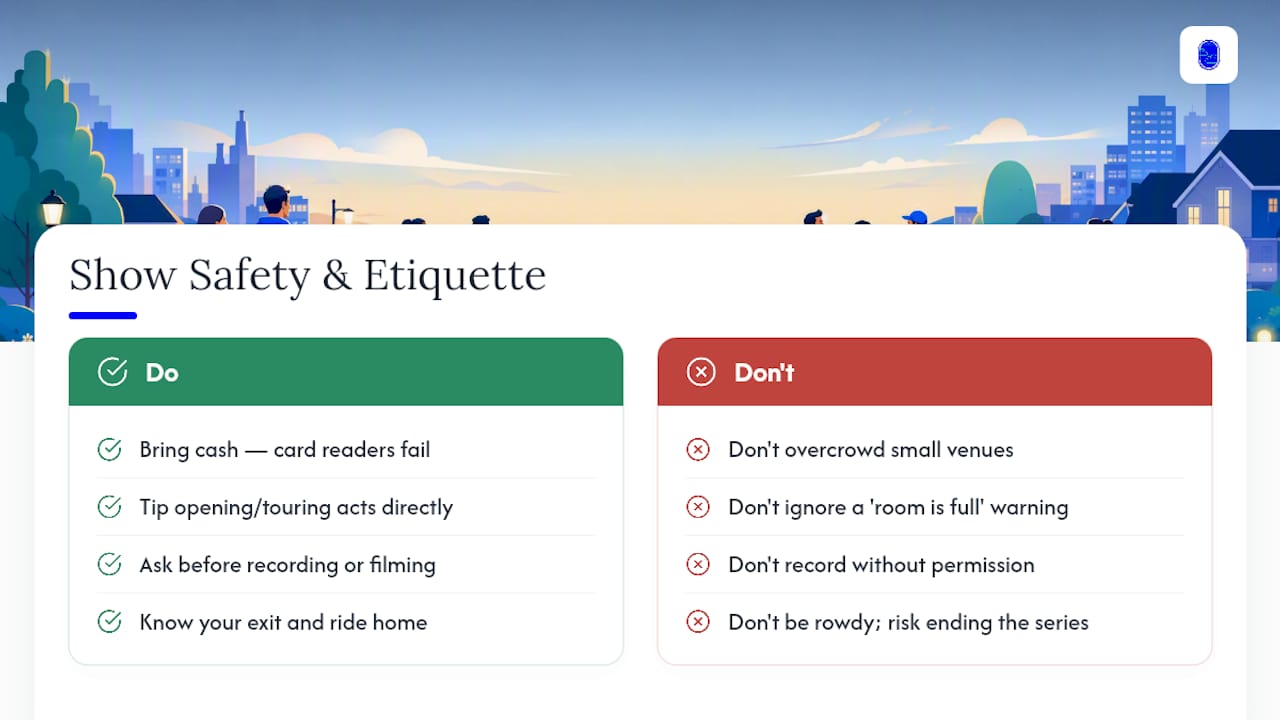
Arrive with cash, even if a listing accepts cards. Small venues and house shows frequently run on a cash box, and card readers fail more often than you'd think. Tip the touring or opening act directly if there's a tip jar; that money often makes up a real share of their pay for the night.
Respect the room's actual capacity. A packed house concert or gallery show is part of the charm, but overcrowding a small space creates real fire-exit risk. If a door person says the room is full, believe them.
Ask before recording. Some artists welcome phone videos; others specifically ask that you don't, especially at intimate or first-time performances. A quick glance at posted signage or a question to the organizer avoids an awkward confrontation mid-set.
Know your exit and your ride home before the show starts, particularly for late-night sets in unfamiliar neighborhoods. Confirm parking or transit access ahead of time rather than scrambling afterward.
Finally, treat the space with the same care you'd want at your own event. Local venues that host recurring nights depend on good guest behavior to keep their lease, their neighbors, and their booking relationships intact. A rowdy crowd at one show can end a whole series.
How Do You Meet People and Build Community at These Shows?
Authentic local shows are some of the easiest places to make real connections, mostly because everyone there chose to be in a small room on purpose.
Show up early. The 20 minutes before a set starts is when regulars chat, organizers mingle, and newcomers get folded into conversation. Arriving right as the music starts skips that window entirely.
Follow the artists and the venue on social media after the show, not just to see future dates but because organizers often reshare attendee posts, which puts you inside the same feed as other regulars. Comment on those posts instead of just liking them; it's a low-pressure way to start recognizing names.
Ask the person next to you how they found out about the show. It's a natural opener at a small venue, and the answer usually leads somewhere useful, a Discord server, a mailing list, another recurring night you hadn't heard of.
Volunteer if the option exists. Recurring scenes almost always need help at the door, with setup, or running merch tables, and coordination spaces like small Discord servers are often where these roles get filled first. Volunteering puts you in the loop faster than attending alone ever will.
Return to the same recurring night more than once. Regulars notice new faces, and by the third or fourth visit, you're not a stranger anymore, you're part of the scene.
What Should You Budget for Authentic Local Shows?
Local shows cost far less than arena tours, but the pricing structure varies enough that it helps to know what you're actually paying for.
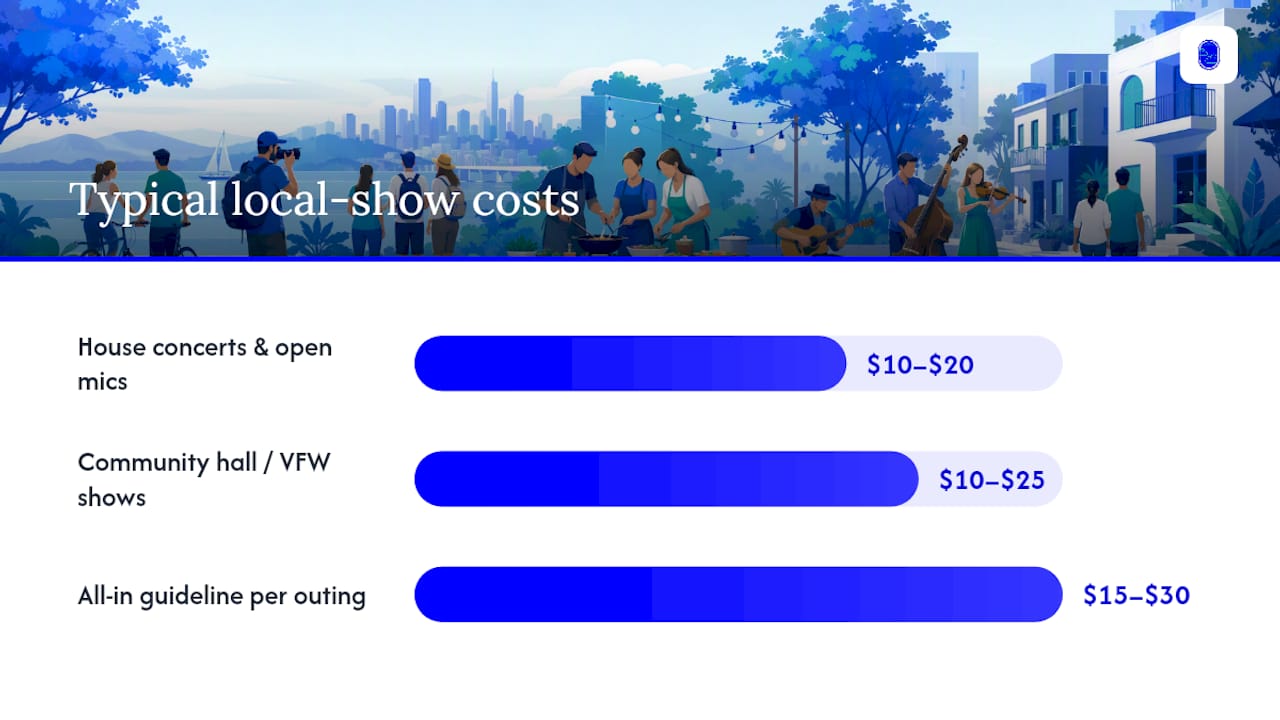
House concerts and open mics typically run on suggested donations, often $10 to $20, or a straightforward pass-the-hat collection. Community hall and VFW shows usually charge a flat door price, commonly in the $10 to $25 range, sometimes with a small cash bar. Gallery and artist-run space events vary more widely depending on whether food or drink is included, but modest pricing is the norm across the category.
Beyond the ticket itself, budget for a few small extras: cash for tips (artists at these shows often rely on tips more than ticket splits), a modest bar tab if the venue serves drinks, and parking if you're not within walking distance. Merchandise, an artist's CD, a zine, a hand-printed shirt, tends to run $10 to $25 and directly supports the performer far more than streaming royalties ever would.
Compare that to typical arena or amphitheater pricing, where fees alone can rival the entire cost of a local show, and the value case for going local gets easier every time. If you're budgeting for a regular habit, a decent guideline is $15 to $30 per outing all in, which makes a weekly local show cheaper than a single big-venue concert most months.
DJ's Take: What Actually Works
Prioritize recurring nights and local partnerships over one-off bookings. Every sustainable scene I've studied traces back to a predictable night and a handful of steady partnerships, not a viral show that never repeats. A weekly open mic with a genre society co-sign builds more loyalty in three months than a flashy single event ever will.
The contrarian tip: stop chasing bigger venues. A packed house concert of 30 people, priced right, often outperforms a half-empty 200-capacity room on both atmosphere and artist pay. Scale later. Build the habit first.
— DJ
Find or List a Show With Experiencebylocals
There are searchable marketplaces built specifically around local, artist-driven shows like those described here, offering an alternative to generic events apps cluttered with group-organizing features. Users can browse listings by neighborhood and genre, view event details from artists and organizers, and book directly without relying on an algorithm to define local events.
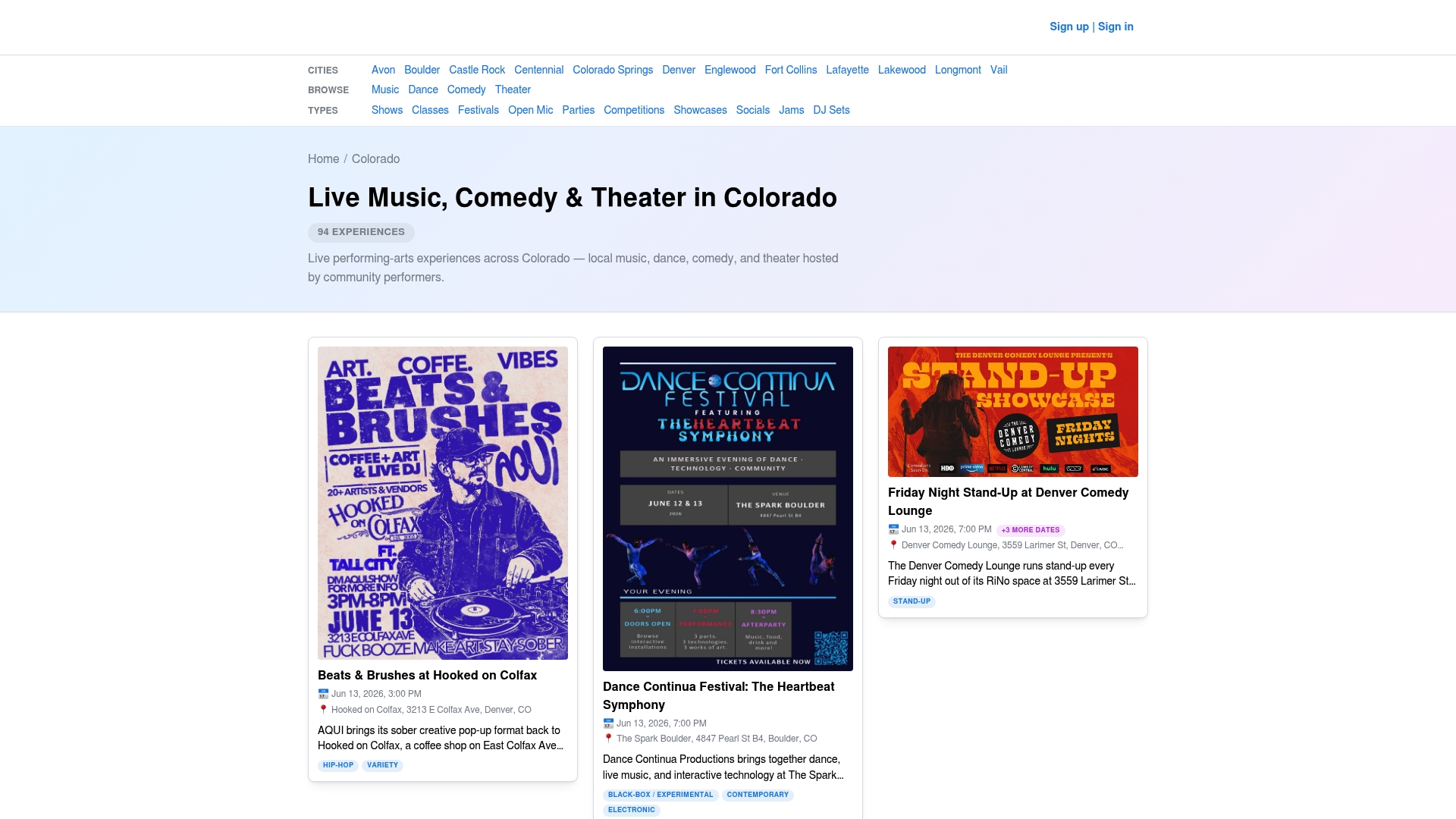
Getting started takes three steps: browse live music listings in Colorado, filter by neighborhood or genre to match the vibe you're after, and if you're an organizer or artist, list your own event directly on the platform. Check current live music, comedy, and theater listings across Colorado today and find your next real show.
Sources
The community tactics in this article draw on practical guidance from Making a Scene's guide to building local music scenes, Folk Alliance International's affiliate network model, and Hypebot's reporting on smaller, locally rooted festivals. For discovery tactics beyond tourist checklists, see Voyasee's guide to resident-focused cultural spaces. For examples of creative spaces that list and host events, The Slate Space offers a useful model of venue-based programming.
- How to create a local music scene effectively – Making A Scene!
- The local advantage: Could festivals win by thinking smaller? — Hypebot
- Folk Alliance International
- Talented
FAQ
What are the best meetup alternatives for finding local live shows?
Searchable event marketplaces like Experiencebylocals, neighborhood social media groups, and community organizations like arts councils or genre societies work better than generic group apps for finding authentic local performances.
How is Experiencebylocals different from Facebook groups for finding shows?
Facebook groups rely on scattered posts and inconsistent moderation, while a dedicated marketplace like Experiencebylocals lets you filter by neighborhood and genre and book directly from artist-listed events.
How much should I expect to pay for a local live show?
Most authentic local shows run between $10 and $25 for the ticket or suggested donation, with house concerts often on the lower end and community hall shows on the higher end.
How can artists list their own shows to reach local audiences?
Artists can list shows directly on a marketplace like Experiencebylocals with clear photos, ticket tiers, and venue details, then promote through neighborhood tags and partnerships with local arts organizations.