
4 Alternatives to Swing in Denver Tonight Using One Local Tool
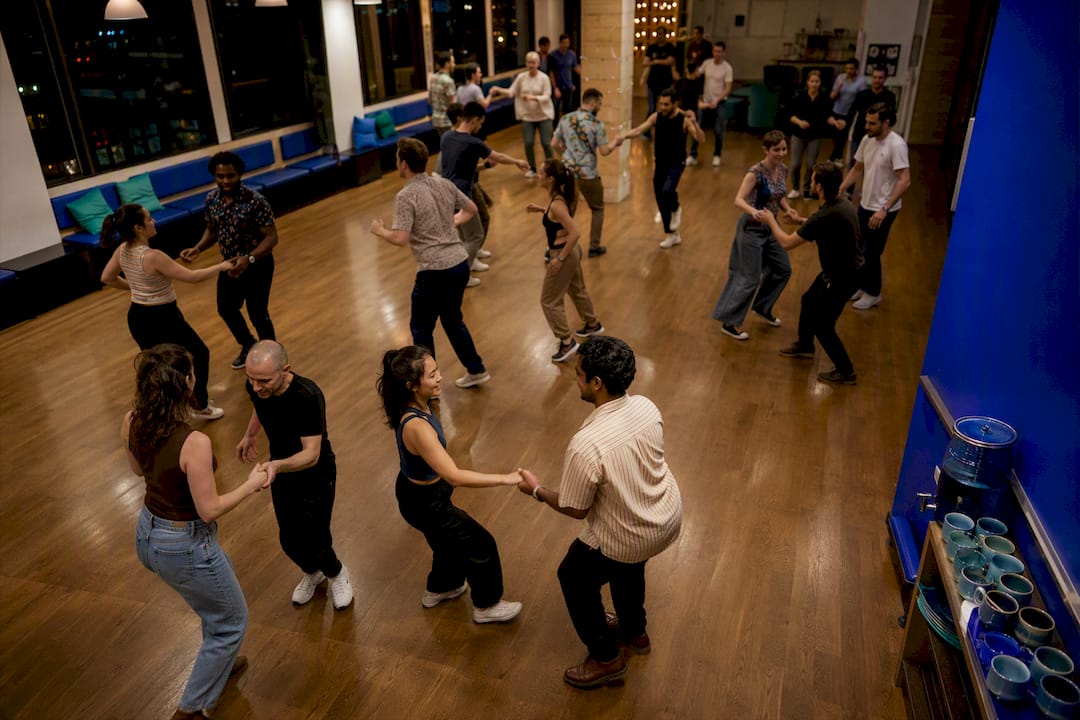
Your best swingindenver alternatives fall into four buckets: weekly community socials at nonprofit dance halls, West Coast Swing–focused nights with lessons built in, multi-week beginner class series, and weekend festivals with visiting instructors. The fastest way to lock in tonight's plan is to check a curated local listings platform like Experience By Locals or a venue's own calendar directly, since swing schedules shift month to month.
TL;DR:
- Weekly socials are the most common dance events in Denver, featuring a short beginner lesson followed by social dancing, with no partner needed.
- Drop-in lessons are ideal for casual learning, while multi-week series build skills progressively, and workshops offer intensive, skill-specific instruction.
- Festivals focus on meeting new dancers and trying new music styles, with multiple class tracks and late-night socials, but at higher cost and time commitment.
- Check venue calendars and official event pages directly before planning, and trust the venue's schedule over third-party listings to avoid missed or canceled events.
- Different nights focus on distinct styles such as Lindy Hop, West Coast Swing, or Charleston, so choosing the right event depends on your preferred dance style and music.
Table of Contents
- Weekly Socials and Community-Run Nights in Denver
- Choosing Between Drop-In Lessons, Class Series, and Workshops
- When Festivals Beat Weekly Nights
- A Quick Checklist for Picking Your Alternative
- Finding Reliable Listings Without the Guesswork
- Lindy Hop, West Coast Swing, and Charleston: Which Style Fits Which Room
- Beyond Swingin' Denver: Other Venues and Communities Worth Knowing
- Beginner Resources: Where First-Timers Should Actually Start
- Competitions, Performance Teams, and Advanced Workshops
- Getting to and Parking at Denver's Swing Venues
- What Your First Alternative Night Actually Feels Like
- Find Tonight's Swing Options Without the Endless Tab-Switching
- Sources
Weekly Socials and Community-Run Nights in Denver
Weekly socials are where most Denver dancers actually spend their time, and they follow a pattern you can count on almost anywhere in the city. A short beginner lesson, usually 20 to 30 minutes, runs first. Then the floor opens for social dancing until close. You don't need a partner to show up. You don't need experience either. That's the entire point of these nights.
Denver Turnverein, a community dance nonprofit that's been running programming in the city for decades, hosts exactly this format: weekly social dances paired with classes at modest admission and class pricing. It's the kind of venue where you'll see a first-timer next to someone who's been dancing for twenty years, and nobody thinks that's strange.
A few things to know before you walk in:
- Cover charges at community-run nights typically run in a modest price range, though some nonprofit venues charge less for members.
- The beginner lesson is almost always optional. Arrive late and you can still jump into the social.
- Etiquette matters more than skill. Asking someone to dance and gracefully declining are both normal parts of the culture.
- Wear shoes with a smooth sole. Sneakers grip the floor and make turns rough on your knees.
- Bring cash or a card for the door. Some venues are still cash-preferred.
Social etiquette in Denver's swing scene leans friendly but has real norms. Rotating partners is expected, not optional, and sticking with the same person all night is considered a little unusual at a community social. If someone asks you to dance, the polite move is to say yes unless you genuinely need a break, in which case a quick "I need to sit this one out" works fine. Nobody is grading your footwork.
Pro Tip: Show up 15 minutes before the lesson starts. The first few minutes are when regulars introduce themselves to newcomers, and that's usually how you find your first few dance partners for the night.
Timing-wise, most weekly nights run from around 7:00 PM to 10:00 or 11:00 PM on a weeknight, with the lesson at the front end and the open social taking up the bulk of the evening.
Choosing Between Drop-In Lessons, Class Series, and Workshops
Not every class format fits every goal, and picking the wrong one is the most common reason beginners quit after two weeks.
- Drop-in lessons work best if you want a casual, low-pressure introduction with zero commitment. You pay per class, skip weeks without penalty, and the material resets often enough that missing a session doesn't wreck your progress. The tradeoff is slower skill building since the material rarely builds on itself week to week.
- Multi-week sessions, typically four to six weeks long, are the better choice if you actually want to improve. Local swing schools like Swing Nights Denver run structured Lindy Hop, Jitterbug, and Charleston series where each week builds on the last. Expect to pay a moderate fee for a full session, depending on length and instructor.
- Workshops are one-off, deep-dive sessions, often two to three hours, focused on a single skill like musicality or a specific pattern. They cost more per hour than a class series but deliver concentrated instruction you won't get in a weekly rotation.
Style pairing tends to follow format. Lindy Hop and Charleston show up most often in the multi-week series and at community socials. West Coast Swing gets its own dedicated nights, frequently with a lesson built into the cover charge rather than sold separately.
When Festivals Beat Weekly Nights
Weekly socials teach you to dance in a room you already know. Festivals teach you to dance with people you've never met, to music you didn't expect, taught by instructors flown in from other scenes entirely. That's the real difference, and it's why serious dancers treat festivals as a different category of event rather than a bigger version of the same thing.
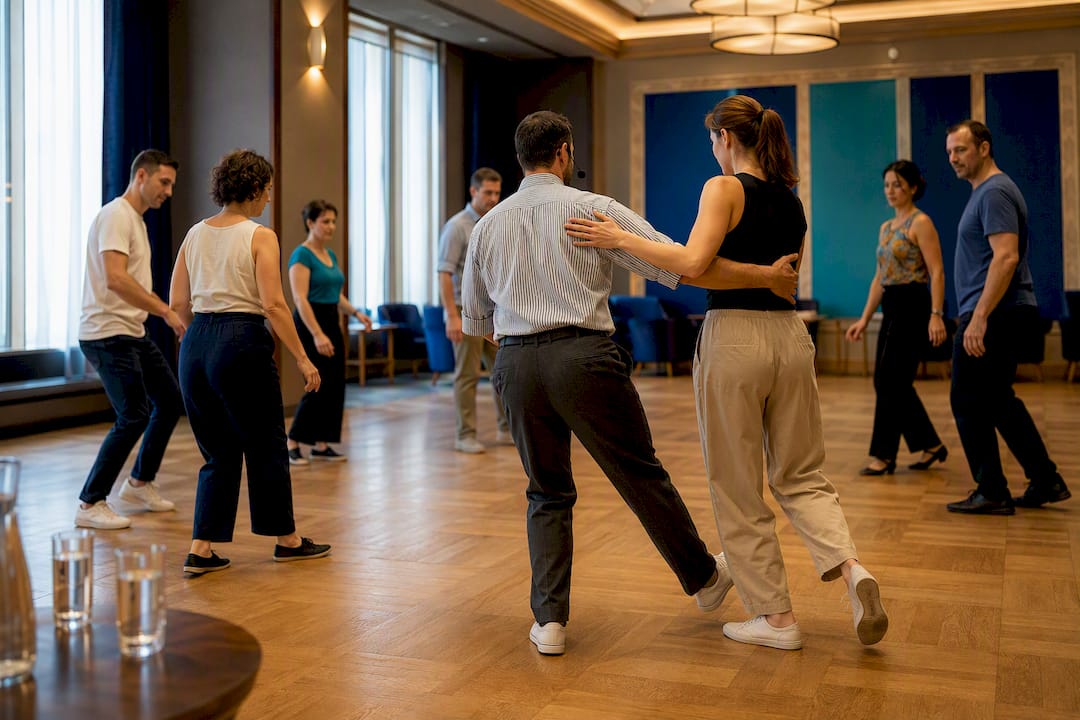
Practitioner guidance on Colorado's festival circuit confirms this split: festivals function as the primary hubs for intensives and visiting instructors, while weekly socials stay focused on regular practice and community connection.
A festival weekend typically includes multiple tracks of classes taught by instructors who travel the national circuit, along with late-night social dances that run well past what a weekly venue would allow.
- Multiple tracks of classes taught by instructors who travel the national circuit.
- Late-night social dances that run well past what a weekly venue would allow.
- A concentrated dose of new patterns and styling ideas you won't pick up from months of weekly classes alone.
The tradeoff is cost and time. A full festival pass can be costly once you add lodging, and it's a weekend commitment rather than a single evening. Beginners should look for tracks explicitly labeled "beginner" or "newcomer" and register early, since early registration pricing is almost always the cheapest tier available.
A Quick Checklist for Picking Your Alternative
Before you commit a Tuesday night or an entire weekend, run through five questions. Are you after social fun or focused skill building? Weekly socials and drop-in nights serve the first goal; multi-week classes and festivals serve the second. What's your actual schedule, and does the venue's partner rotation policy match your comfort level? What's the room's general vibe, since a nonprofit dance hall feels different from a nightclub-style swing night? What's your budget, and does the venue have a clear refund policy for classes? And finally, does the event have a consistent, easy-to-find schedule, or does it seem to move around without warning?
| What you're checking | Weekly social night | Multi-week class series | Weekend festival |
|---|---|---|---|
| Best for | Social practice, meeting people | Steady skill progress | Accelerated learning, networking |
| Typical cost | modest price range | moderate fee per session | Can exceed several hundred dollars with lodging |
| Commitment | None, drop in anytime | typically several weeks | One weekend |
| Partner needed | No | Usually no | No |
A red flag worth trusting your gut on: if a venue's schedule keeps changing without explanation, or nobody answers a basic message about start times, that's usually a sign the organization is inconsistent, not that you're missing something.
Finding Reliable Listings Without the Guesswork
Venue calendars and event pages remain the most trustworthy source for confirming times and prices, since community reposts and secondhand listings can lag behind real changes. Dedicated scene guides fill in the gaps that a single venue's calendar can't cover. LindyPlus's Denver city guide consolidates local teachers, recurring events, and bands into one reference point, which is genuinely useful when you're trying to figure out who teaches what across the city.
Experience By Locals takes a different approach by curating grassroots events directly from local hosts, including community-run nights that larger calendars sometimes miss entirely. Because listings link straight to booking pages and event details, you can confirm a date and grab a ticket in the same step rather than bouncing between five different sites.
A few habits worth building:
- Always click through to the host's own event page before finalizing plans, not just a repost.
- Check for a listed start time for the lesson versus the open social. They're not always the same.
- Look for recent activity or updates on the listing. A stale page is a warning sign.
Pro Tip: If two sources disagree on a start time, trust the venue's own page over any third-party listing. Cancellations and time changes update there first.
Lindy Hop, West Coast Swing, and Charleston: Which Style Fits Which Room
Denver's swing scene isn't one dance. It's three or four related styles that show up in different rooms depending on the crowd and the music.
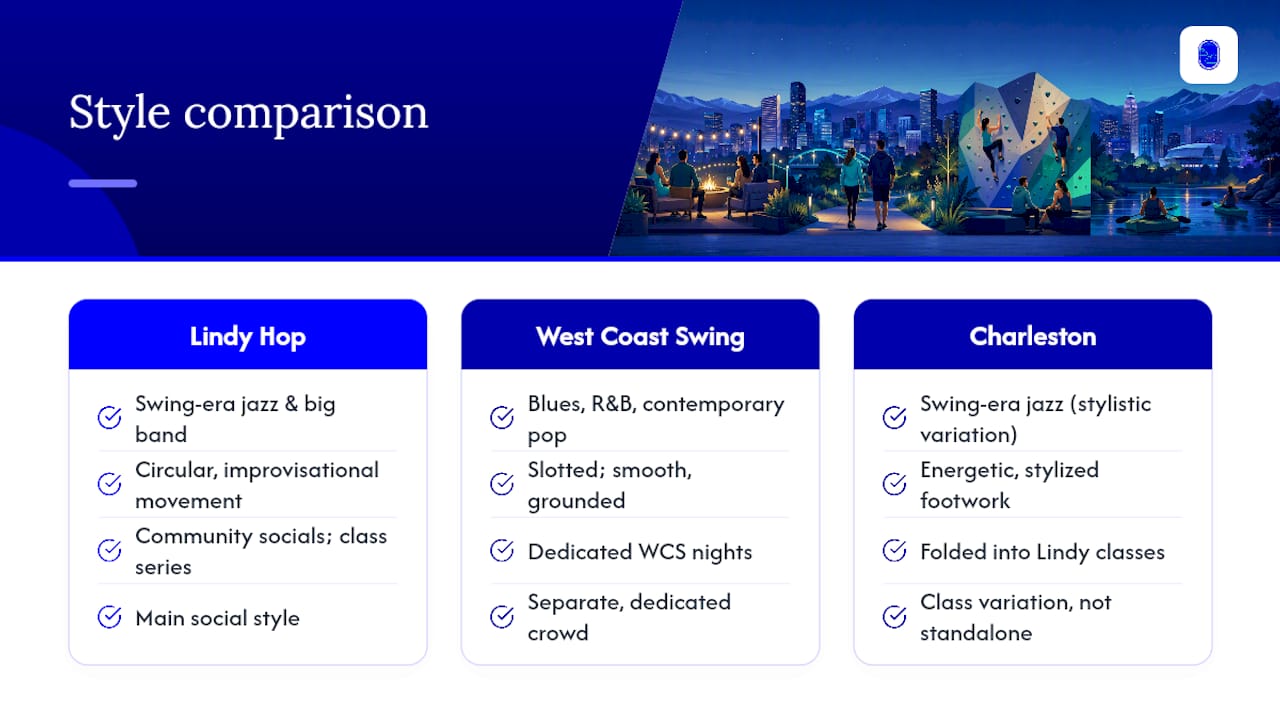
Lindy Hop is the style you'll see most at community socials and in multi-week class series. It's built for swing-era jazz and big band music, moves fast, and rewards dancers who like improvisation within a structure. If a venue's playlist leans toward horns and upright bass, you're probably in a Lindy room.
West Coast Swing runs on a different rhythm entirely, built for blues, R&B, and contemporary pop, and it draws its own dedicated crowd on nights set aside specifically for it. These nights tend to be smoother and more grounded, with a slotted rather than circular movement pattern. If you've heard someone describe a night as "WCS" rather than just "swing," that's the tell.
East Coast Swing and Charleston show up more as foundational pieces within Lindy-focused classes than as their own dedicated nights in Denver. East Coast Swing is often the first pattern beginners learn because it's simpler to pick up quickly, while Charleston gets folded into intermediate Lindy classes as a stylistic variation rather than taught as a standalone track.
Knowing which style a night favors before you show up saves you the awkwardness of learning the wrong footwork mid-song.
Beyond Swingin' Denver: Other Venues and Communities Worth Knowing
Denver's swing scene has real depth beyond any single organization, and local journalism has tracked this for years. CBS News Colorado's coverage of Denver's swing dance clubs documented a scene built around multiple venues rather than one central hub, and that pattern holds today.
Denver Turnverein remains the closest thing to an institution in the local scene, running weekly social dances and classes as a nonprofit with community roots that predate most current swing organizations in the city.
Independent swing schools add another layer entirely. Swing Nights Denver runs its own mixed-format classes covering Lindy, Jitterbug, and Charleston, publishing calendars for both monthly special events and weekly regular sessions. That's a meaningfully different experience from a purely social venue, since the emphasis stays on structured instruction rather than open dancing.
Beyond these named organizations, smaller pop-up socials and one-off events surface regularly around Denver, often tied to a specific bar, brewery, or community space for a single night rather than a recurring weekly slot. These are usually the hardest to find through a standard search, since they don't maintain a permanent web presence the way an established venue does. That's exactly the kind of listing where a curated events platform earns its keep instead of a generic search engine.
Beginner Resources: Where First-Timers Should Actually Start
If you've never danced swing before, skip straight to a beginner-labeled event rather than trying to ease into a general social. Most weekly nights at community venues build a beginner lesson directly into the evening, which means you get instruction and social practice in the same two or three hour block without needing a separate class registration.
Introductory workshops, often marketed as "newcomer" or "intro" sessions, are the next step up. These run longer than a standard pre-social lesson, usually an hour or more, and focus entirely on the basics: rhythm, the core step pattern, and how to lead or follow a simple turn. They're worth seeking out specifically because a rushed 20-minute lesson before a social sometimes moves faster than a true beginner needs.
A practical sequence for a first-timer looks like this: attend one beginner-focused workshop or intro class first, then follow it with two or three weekly socials to practice what you learned in a low-stakes setting, and only after that consider a full multi-week series. Jumping straight into an intermediate class series without this groundwork is the most common reason newcomers feel lost in week two.
Community pages and event hosts usually flag beginner-friendly nights clearly in the event description, so read the fine print before assuming a night is appropriate for your level.
Competitions, Performance Teams, and Advanced Workshops
Once weekly socials and beginner classes start feeling routine, Denver's scene has real paths for going further. Performance groups exist within several of the city's swing schools, giving intermediate and advanced dancers a chance to choreograph and perform routines at local events, festivals, or community showcases rather than just social dancing.
Competitive swing dancing operates on a different track, usually tied to regional and national circuit events rather than anything local and weekly. Dancers who want to compete typically train through a combination of multi-week classes, private coaching, and festival workshops specifically built around competition prep, like strictly-and-jack-and-jill formats.
Advanced workshops, the kind built around a single technical skill rather than a beginner overview, show up most often at festivals rather than as standalone weekly events. That's part of why the festival circuit matters even for dancers who mostly stick to local nights: it's frequently the only place in the region to get direct instruction from touring-level instructors on advanced material.
If you're aiming in this direction, talk to instructors at your regular multi-week series first. They generally know which festivals and workshops in the coming months are worth the drive and the entry fee for someone at your specific level.
Getting to and Parking at Denver's Swing Venues
Most of Denver's swing venues sit in neighborhoods where street parking is workable but not guaranteed, so building in a few extra minutes before a weeknight lesson starts is smart. Nonprofit dance halls and community venues tend to have dedicated lots or nearby free street parking, especially on weeknights when surrounding businesses have closed for the day.
Weekend festival venues are a different story, particularly when they're held at larger event spaces or hotels. Expect paid lot parking in those cases, and check the festival's own event page ahead of time, since many list specific parking guidance or nearby garage recommendations for attendees.
RTD's light rail and bus network covers a meaningful chunk of central Denver, and it's worth checking whether your venue sits near a station before defaulting to driving, especially for evening events where parking near nightlife districts gets tighter. Rideshare is the simplest fallback if you're headed somewhere unfamiliar or attending a late-night social that runs past transit hours.
A little planning here matters more than it seems. Arriving flustered from a parking scramble is a rough way to start a beginner lesson.
What Your First Alternative Night Actually Feels Like
You walk in a little early, unsure where to put your bag. Someone near the door smiles and points you toward the lesson area. The instructor runs through a basic step, slower than you expected, and by the third repetition your feet stop thinking so hard about it. Then the music changes, the lesson ends, and the floor just opens up.
That transition is the part people underestimate. It feels less like a performance and more like showing up to a friend's living room where everyone happens to know the same six steps.
Pro Tip: If your nerves spike right before the social starts, ask the person next to you what song just played. It's a small, easy icebreaker that gets you talking before you're asked to dance.
Try at least two different nights before deciding what fits. A West Coast Swing evening and a Lindy-focused social feel almost nothing alike.
— DJ
Find Tonight's Swing Options Without the Endless Tab-Switching
Cross-checking five different venue calendars just to find one dance night that fits your schedule gets old fast. Experience By Locals solves that specific problem for Denver's dance scene by pulling grassroots events, community-run nights, and studio classes into one searchable place, so you're not the one doing the legwork.
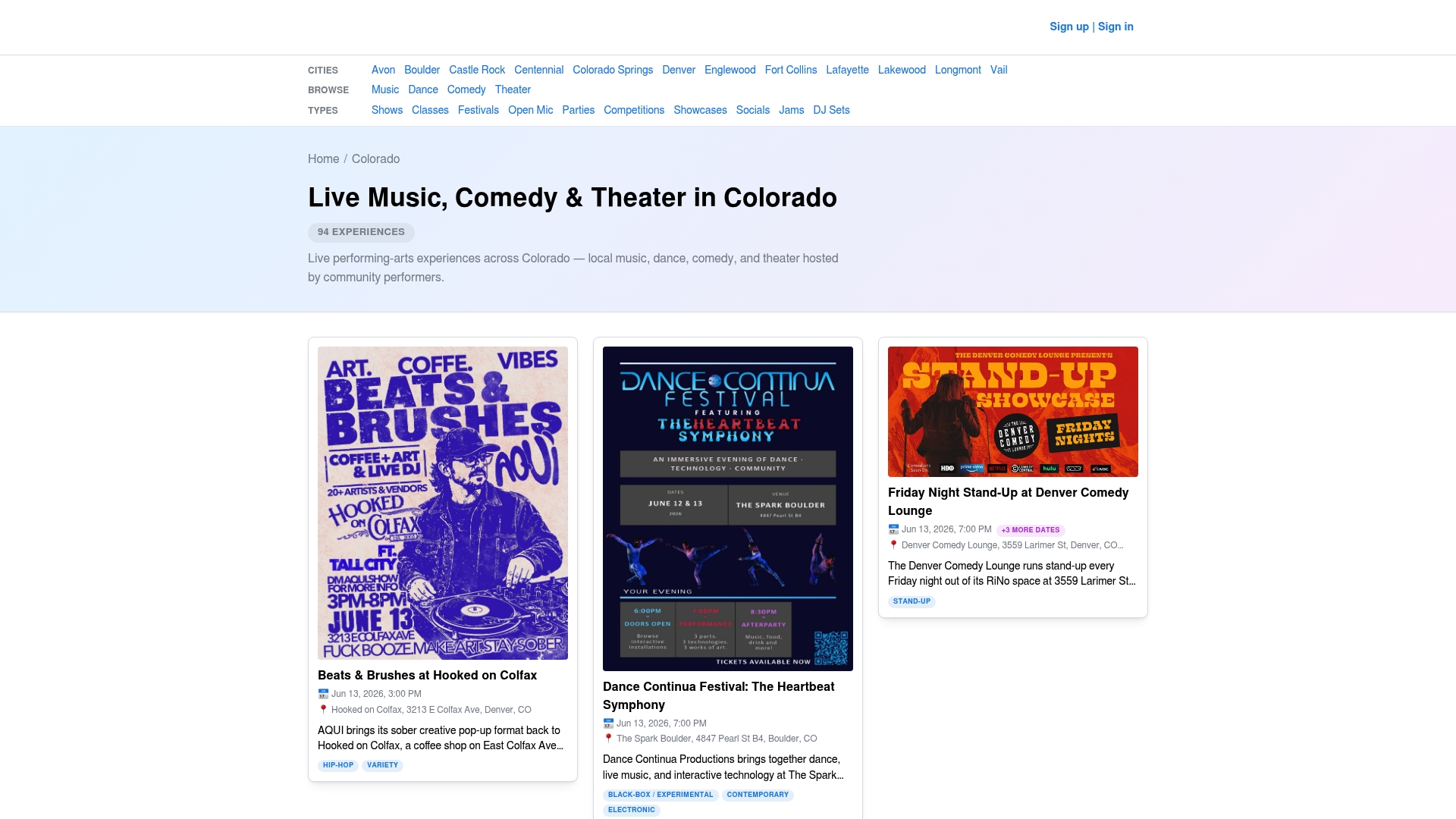
The platform lets you filter by date, neighborhood, and dance style, which matters if you already know you want West Coast Swing on a Thursday rather than a general swing night wherever you can find one. Every listing links straight to booking details and event specifics, so you can confirm a time and grab a spot in the same visit instead of hopping between a venue site, a social media page, and a ticketing link. It's built around real local hosts and creators, not national franchise listings, which is exactly the gap that matters most for something as community-driven as swing dancing.
Search "dance" on the Denver events page tonight, or browse the broader Colorado dance category if you're planning a weekend trip and want to see what's happening beyond one city.
Sources
For weekly calendars, go straight to Denver Turnverein's own page rather than a secondhand repost. For teacher directories and a broader view of the scene, Lindy.plus's Denver guide consolidates names and events in one spot. For festival and workshop specifics, check organizer pages like Colorado Mountain Dance directly. Whatever you find, confirm the actual date and time on the host's own event page before you commit your evening.
- LindyPlus — Swing Scene city guide: Denver
- Top swing dance clubs in Denver — CBS News Colorado
- Colorado Mountain Dance — event listing and festival info
- Swing Nights Denver — classes and events