
Dance Collectives in Denver: How to Find and Join Them

A dance collective in Denver is a group of artists who make and present movement together, usually sharing costs, space and audiences instead of answering to a single studio owner or a large company board. You can watch them at community showcases, theater nights, dance parties and artist-run spaces across the metro area, and if you are a dancer, many of them welcome new collaborators. This guide explains how collectives work, what you will see on stage, how to get involved, and how to find a show this weekend. 🎶
TL;DR
- A collective is artist-driven: members pool resources, share production costs and often rotate who leads, unlike a traditional studio or a company with a fixed roster.
- Denver's scene spans contemporary ballet, Flamenco, tap, hula hoop, performance art, Bolivian ballroom and more, often in a single mixed-bill evening.
- Dancers can find paid and unpaid opportunities through city programs, cost-sharing showcases, open classes and local listings.
- Audiences should check the venue, the lineup, the ticket host and the start time before heading out, because small shows change.
- We list local dance events across Denver and Colorado so you can browse and book directly with hosts.
Table of Contents
- What "dance collective" actually means in Denver
- How the cost-sharing model works
- What styles and formats you'll see
- What to expect when you attend
- How dancers can get involved
- Tips for choosing the right collective
- Where and when Denver dance happens
- Our perspective
- Find your next dance night 🔎
- FAQ
- Sources
What "dance collective" actually means in Denver
The word gets used loosely. In Denver you will hear it applied to a company of choreographers, a drop-in class community, a producing series, and a loose circle of friends who rent a room and put on a show. What they share is the way they operate: the artists themselves run the thing.
Compare that with the other two models you will run into:
| Dance studio | Established dance company | Dance collective | |
|---|---|---|---|
| Main purpose | Training and classes | Repertory performance by a salaried or contracted ensemble | Making and sharing work together |
| Who decides | Owner or director | Artistic director and board | Members, often by consensus or rotating roles |
| Money | Tuition | Grants, donations, ticket sales | Shared costs, pooled ticket revenue, small grants |
| Entry point | Sign up for a class | Audition | Show up, collaborate, be invited, or apply to a showcase |
The lines blur, and plenty of groups do more than one of these things. A studio might host a collective's rehearsals. A collective might grow into a company. That is part of what makes the scene fun to explore: you rarely meet the same format twice.
One well-documented example of the collective spirit is Convergence, which Westword describes as a grassroots cost-sharing performance series that has marked a decade of showcasing Colorado dance. Its model is a useful lens for understanding what collective means in practice, and we will come back to it below.
How the cost-sharing model works
Putting on a professional dance concert is expensive. Theater rental, lighting, tech, marketing and documentation add up quickly, and a small group of artists can find the bill out of reach. The Convergence model was developed in response to those steep costs, and the way it works is a good picture of collective thinking.
According to the same Westword report, participants contribute a portion of the production costs based on what they can afford, and ticket sales are then redistributed according to those same percentages. The model can help groups break even or even profit, and it provides professional photo and video documentation, something small artists rarely afford alone.
Why does this matter to you?
- As an audience member, it means the performers on stage are often funding and shaping the evening themselves. Your ticket goes straight into the artist community.
- As a dancer, it shows there are ways to perform in a professional setting without having to carry the entire budget yourself.
- As a choreographer, it opens a path to a real stage, with real documentation, before you have a company of your own.
What styles and formats you'll see
Denver collectives are not tied to one genre. A mixed-bill night can feel like a small world tour in two hours. The Convergence lineup alone, as reported by Westword, has brought together contemporary ballet, Flamenco, tap, hula hoop, performance art and Bolivian ballroom.
Beyond that, expect to find some of these formats around the city:
Mixed-bill showcases
Several short pieces from different artists in one evening. These are the easiest way to sample the scene. If one piece does not speak to you, another will arrive in ten minutes. Because the lineup is different each time, you will see something new at every performance, a point the Convergence coverage makes about its own series.
Cultural and traditional dance
Denver's communities bring their own traditions to the stage, from Latin American folk and ballroom styles to dances rooted in other world cultures. These evenings often include live music, costume and a short introduction from the performers, which makes them welcoming even if you have never seen the form before.
Community dance parties and open sessions
Not every collective is about a stage. Plenty of groups build community through social dancing: themed dance nights, ecstatic or free-movement mornings, drop-in classes for adults and styles like swing, salsa or ballroom. You will find the energy more participatory than observational, and many are explicitly open to beginners.
Artist-run spaces
Some of the most memorable performances happen in small, artist-run rooms where the audience sits a few feet from the dancers. We wrote about why these spaces matter in our piece on artist-run studios in dance communities. They give emerging artists a low-pressure place to try new work and give audiences a close, unfiltered view of the craft.
What to expect when you attend
Grassroots shows are friendlier and often shorter than a big-theater production. A few things are worth knowing before you go:
- The lineup may be a surprise. Many collective events present different artists each time, so there is no "same show" to compare with last month's.
- Venues are varied. One night may be in a proper theater, the next in a studio, a community hall or a club. Check the address and parking or transit options ahead of time.
- Seating can be limited. Small rooms fill up. Booking ahead through the listing is the simplest way to be sure of a spot.
- Ask about what you can bring. Some events welcome cameras for pre-agreed moments, others ask you to keep phones away. The host's event page usually says.
- Arrive a little early. Many shows start on time, and a mixed bill rewards watching from the first piece.
- Say hello afterward. Performers at community shows are almost always happy to chat, and that connection is half the point.
Before you go: a quick checklist
- ✅ Confirm the date, start time and doors time on the event page
- ✅ Check the venue address and accessibility details
- ✅ See whether the show is all ages or has an age guideline
- ✅ Look at who is performing, so you know what styles to expect
- ✅ Read the host's notes on tickets, refunds and any seating rules
How dancers can get involved
If you are a performer, Denver offers more doors than most people realize. Here are the ones worth knowing about.
Apply to a city program
The 16th Street Performers Network, run by Denver Arts & Venues, is a roster of individual artists and ensembles of up to three performers who activate downtown Denver. Selected artists are paid $150 per performer per performance hour, performances generally run between 10:00 a.m. and 9:00 p.m., applications are reviewed quarterly, and artists stay on the roster for two years. For a solo dancer or a small trio, it is a way to be paid for work in public space. Check the official page for the current application window.

Join a cost-sharing showcase
If you have a finished piece and want a professional stage, series built on the pooled-cost model described earlier are a natural fit. Contribution is scaled to what you can afford, which lowers the barrier for early-career choreographers.
Show up to open classes and community sessions
Drop-in classes and open sessions are how many collectives recruit. You meet people, you see how they work, and the invitation to collaborate usually happens organically. Go regularly rather than once, and you will become a familiar face fast.

Build the practical side
Being a movement artist is more than dancing. SpaceTalks, an organization for dance and movement artists, points to the challenges artists face: finding rehearsal space, running a small business, connecting with collaborators, taking care of your body, and understanding independent contractor status. Its view is that the community is better together, and that sharing knowledge makes tools more accessible so no one has to figure it out alone. That is a good attitude to bring to any collective you join.
Creative work also needs fuel. If you are building a piece around a vintage groove or a rare pressing, browsing Denver record stores is a pleasant way to dig for sounds, and a good excuse to meet more of the city's creative community.
Put your own event in front of an audience
Once you have a show, you need people in the seats. On our platform, artists and hosts can list events and let audiences book directly. Browse how other creators present their work on our Denver live performances page before you list your own.
Tips for choosing the right collective
Not every group will fit you. A few questions help you find your people:
- What is their style? Contemporary, cultural, social, improvisational? Pick the one that excites you, not the one that sounds most impressive.
- How do they make decisions? Some collectives are fully democratic, others have a lead choreographer. Neither is wrong, but you should know in advance.
- What do they expect from members? Rehearsal hours, dues, show commitments. Ask before you say yes.
- Who is the audience? A group that performs mostly at community festivals will give you different experience than one that does ticketed theater runs.
- Does the energy feel right? Trust the room. The best collectives feel like a place where people show up for each other.
Where and when Denver dance happens
There is no single calendar for the whole scene, and that is the challenge. Shows pop up at theaters, studios, clubs, community centers and festival stages, often announced a few weeks out. Social dance nights tend to follow a regular rhythm, like weekly or monthly gatherings, while showcases run a few times a year. Always confirm the current schedule on the host's page.
If you are interested in a particular style, narrow your search:
- For ballroom evenings and social dancing, see our Denver ballroom events and our local guide to Colorado DanceSport ballroom.
- For a taste of Denver's inclusive party scene, take a look at Playhaus: Denver Pride Dance Party.
- If you are willing to travel a little, check out dance performances in Boulder.
Our perspective
We built Experience By Locals because the best performances in Colorado are often the hardest ones to find. Tourist-heavy venues get the marquee, while the choreographers, comedians and musicians who give a community its voice are sharing work in studios, theaters and small rooms that never make the top of a search.
Dance collectives are the clearest example. They are made by people who care enough to share costs, swap rehearsal space and show up for each other. When you buy a ticket to one of their shows, you are not just seeing a performance. You are supporting a way of making art that keeps the scene open to newcomers.
That is why our platform focuses on local hosts. We want guests to find authentic dance, comedy, music and theater, and we want creators to reach an audience without needing a big marketing budget. Browsing is free, and when you book, you book directly with the host.
If you are a dancer wondering whether your work belongs in front of an audience, it does. Start small, share often, and find the people who make you better. 🤝
DJ
Find your next dance night 🔎
Ready to see local dance in person? We list live music, dance, comedy and theater hosted by community artists across Colorado, and you can browse, filter and book directly with event hosts.
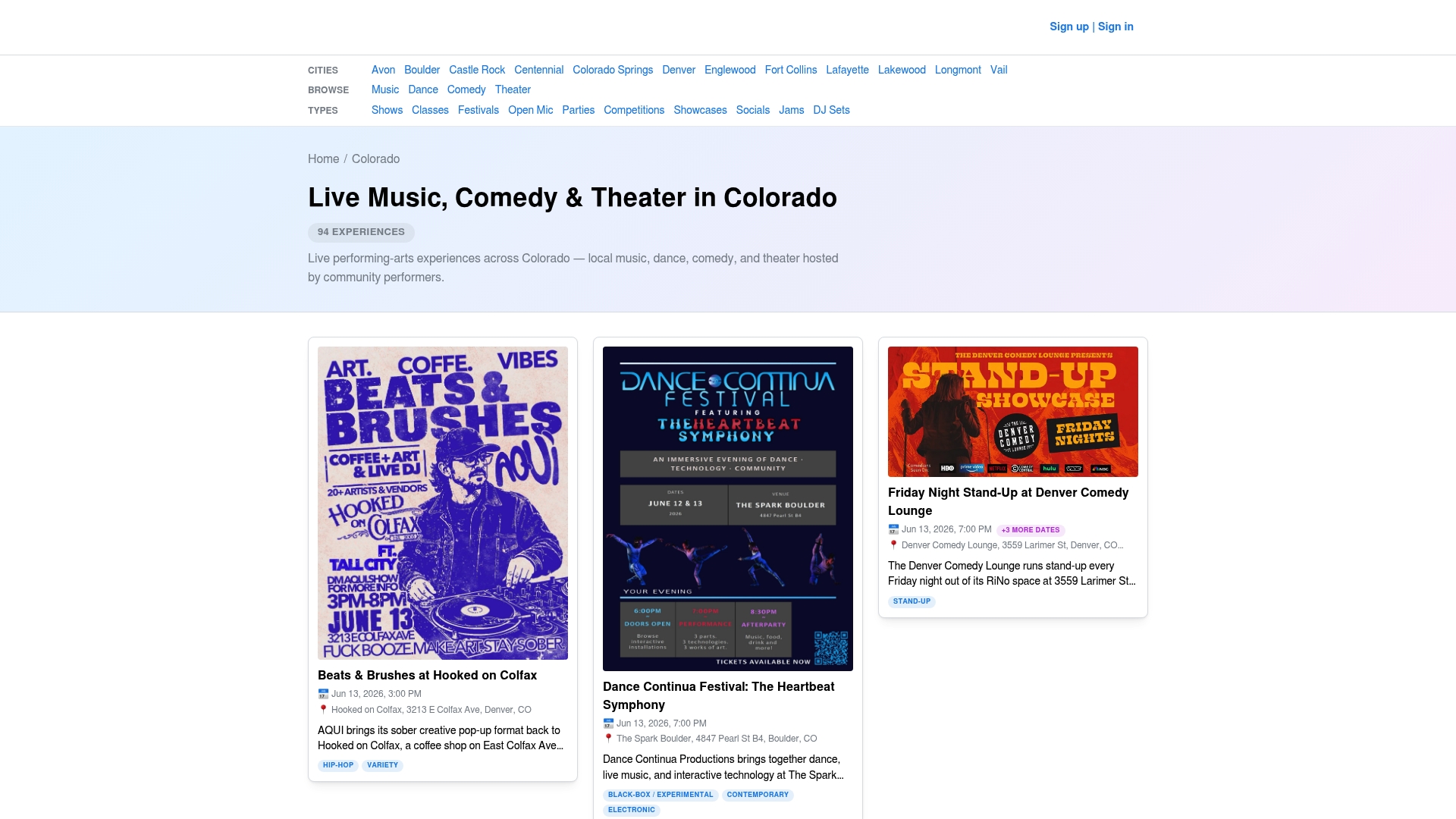
Start with dance performances across Colorado, or explore the wider Denver events page for music, comedy and theater too. If you are an artist, we would love to hear from you: list your event and let your community find you. You can also meet one of the groups on our platform through the New Breed Dance Company performer page.
FAQ
What is a dance collective?
A dance collective is a group of artists who create and present movement together, sharing responsibilities, costs and creative decisions. Unlike a studio, the focus is on making work rather than selling classes. Unlike a large company, there is often no single director at the top.
How do I join a dance collective in Denver?
Start by attending their open classes, sessions or showcases, then introduce yourself to the organizers. Many groups bring in collaborators through relationships rather than formal auditions. Ask what the group expects from members, such as rehearsal time or contributions to show costs, before committing.
Can dancers get paid for performing in Denver?
Sometimes. The 16th Street Performers Network, run by Denver Arts & Venues, pays selected artists $150 per performer per performance hour for downtown performances. Applications are reviewed quarterly, so check the official page for the current process. Showcases built on cost-sharing can also help groups break even or earn from ticket sales.
Are collective performances suitable for beginners in the audience?
Yes. Mixed-bill nights are a friendly way to try dance, because pieces are short and styles vary. You do not need to know technique or terms to enjoy them. Read the event description for age guidance and any seating details before you book.
How do I find upcoming dance shows in Denver?
Browse our dance listings for Colorado and filter by city and style, then book directly with the host. Since small shows are announced on shorter timelines, check back regularly for new events.
Sources
- Convergence Event Marks Decade of Showcasing Colorado Dance, Westword
- 16th Street Performers Network, Denver Arts & Venues
- SpaceTalks