
Find Comedy Shows Near You Fast: What Ticket Sites Miss

The fastest way to find comedy shows near you is to check venue calendars first, then cross-reference with Experience By Locals for community-driven listings that ticket marketplaces miss entirely. Search by your city and date, sign up for a venue's email list, and check social media for pop-ups. That three-step combo covers a large portion of what's happening in your area this week.
TL;DR:
- Venue calendars are the most reliable source for accurate, up-to-date comedy show listings, with direct confirmation from the venue’s own website.
- Social media platforms like Instagram and Facebook are ideal for discovering last-minute pop-up shows and open mics not listed elsewhere.
- Community-driven platforms like Experience By Locals focus on grassroots shows and direct booking, supporting local artists rather than tour-based ticket marketplaces.
- Always verify show details through the venue’s official site before purchasing tickets, especially when buying from third-party resellers or marketplaces.
- Attending festivals or open mics offers greater variety and discovery, but premium tickets or large arena shows require early booking and careful cost consideration.
Table of Contents
- How to find comedy shows near you: a prioritized checklist
- What types of comedy shows should you look for?
- How do you pick the right show and avoid ticket problems?
- What should you expect on the night of the show?
- Experience By Locals: how the platform helps you find authentic comedy shows
- How do you verify a comedy show is real before you buy tickets?
- How can apps and alerts help you catch new comedy shows fast?
- Are there discounts or membership perks for regular comedy fans?
- Why local-first search beats the algorithm every time
- Ready to see what's playing near you tonight?
- Sources
How to find comedy shows near you: a prioritized checklist
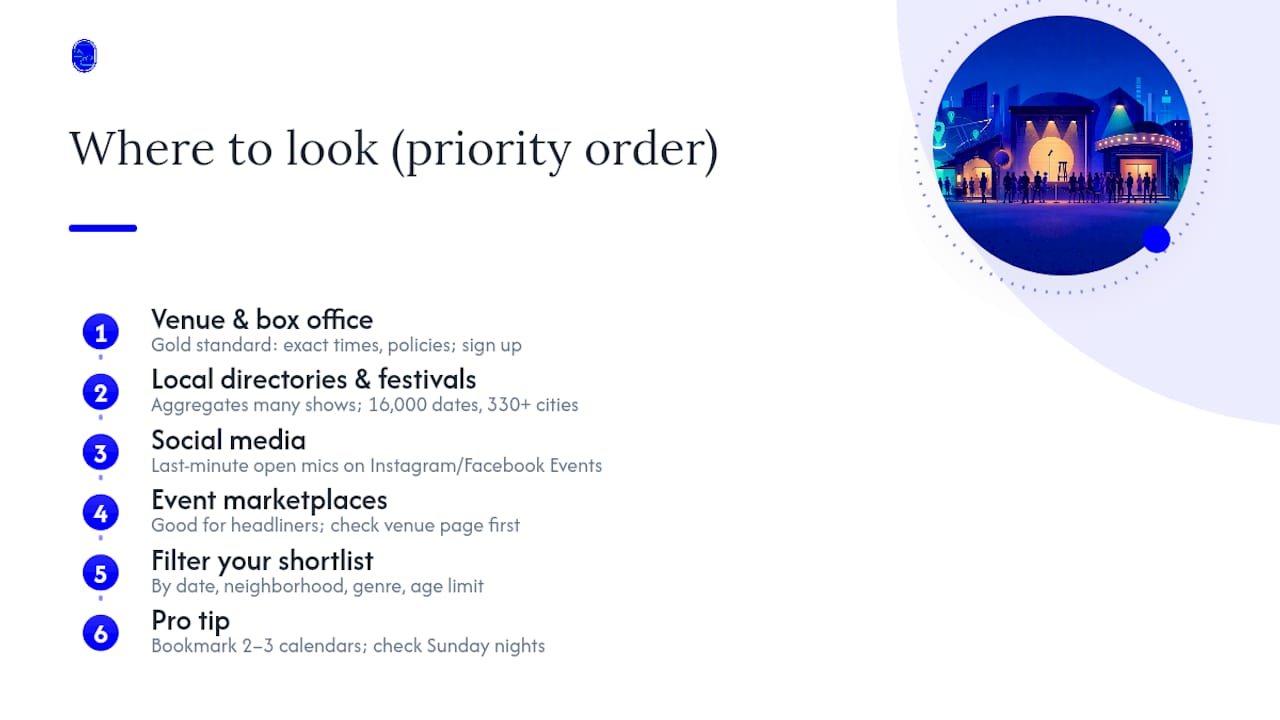
You've got more sources than you think, but they're not all equally reliable. Here's the order that actually works, from most trustworthy to "verify before you buy."
Start with venue and box office calendars. Comedy clubs and theaters post their own schedules directly, and those listings are the gold standard for accuracy because they come straight from the source. A club's website will tell you exact showtimes, age restrictions, and seating policy, details you won't always get from a third-party listing. Sign up for the mailing list of any club you like. Most send a weekly rundown, and that's often how you hear about a surprise drop-in from a touring headliner before it hits any public listing.
Check local event directories and festival pages next. Larger directories aggregate hundreds or thousands of shows at once. One national comedy directory tracks more than 16,000 performance dates across 330-plus cities, which makes it useful for scanning a whole region, though you'll want to click through to confirm details on the venue's own page.
Social media is where last-minute stuff lives. Instagram and Facebook Events are where open mics and pop-up shows get announced with two days' notice, sometimes less. Follow local clubs and a few comedians in your area, and you'll start seeing these before they hit any formal listing.
Event marketplaces are good for touring names, with a catch. They're convenient for finding big-name headliners and often show real-time inventory, like "1 ticket left" or flagged deals, but always confirm the show is real by checking the venue's own page before you buy.
Once you've got a shortlist, filter by date, neighborhood, genre, and age limit to cut the noise fast.
Pro Tip: Bookmark two or three venue calendars in your area and check them every Sunday night. Comedy schedules refresh weekly, and Sunday check-ins catch new listings before they sell out.
What types of comedy shows should you look for?
Not every comedy night delivers the same experience, and picking the wrong format for your mood is the most common rookie mistake.
- Open mics and newcomer nights: cheap or free, casual, unpredictable quality, great for discovering someone before they're famous.
- Club nights and showcases: curated lineups, moderate prices, consistent scheduling, usually your safest bet for a solid night out.
- Improv and sketch shows: a different format entirely, often more family-friendly or themed around audience suggestions.
- Touring headliner and arena shows: premium tickets, fully produced, predictable in the best way. Large-venue listings, like a multi-comic benefit lineup at Madison Square Garden, show how far in advance these get scheduled.
- Festivals: multiple showcases packed into one event, often featuring six or more comics per showcase, which makes a single night efficient for discovering new favorites.
If you're new to live comedy, a club showcase is the safest starting point. If you're chasing discovery, a festival or an open mic gets you more variety per dollar.
How do you pick the right show and avoid ticket problems?
Choosing a show is part matching your mood to the format, part avoiding a few predictable traps. Here's the sequence that keeps you from getting burned.
- Compare box office and marketplace prices side by side. Festival showcase listings commonly run $25 to $30 with sets starting around 8:00 to 10:00 p.m., and that's a useful benchmark for what a solid showcase should cost before fees.
- Read the fine print on age limits, seating, and doors time. Independent club listings, like one Greenwich Village show's event page, spell out ID requirements and arrival windows so you're not surprised at the door.
- Budget for a drink or item minimum. Many independent clubs require guests to purchase a minimum number of drinks or items during the show, separate from your ticket. That can add $15 to $25 to your night without warning.
- Look up who's actually on the bill. Decide whether you want an MC-driven lineup with rotating acts or a single headliner carrying the whole set.
- Watch for red flags. A vague refund policy, an unverifiable resale seller, or a checkout process that takes unusually long to confirm your transfer are all signs to walk away and buy elsewhere.
Quick math: a $25 ticket plus a two-drink minimum at $8 each and a service fee can push your real cost past $45. Factor that in before you commit to a "cheap" show.
What should you expect on the night of the show?
Getting the logistics right matters as much as picking a good lineup. A few habits separate a smooth night from a frustrating one.
- Arrive early. Doors commonly open 30 to 60 minutes before showtime, and venues that warn you to arrive 15 minutes ahead or risk losing your seat usually mean general admission, not assigned seating.
- Confirm your seating type before you go. Some clubs assign seats, most don't; knowing which saves you from standing in the back.
- Follow basic etiquette. Silence your phone, skip the heckling unless a performer explicitly invites it, and clap generously, comedians feed off audience energy more than any other performer.
- Check accessibility and food service ahead of time, especially at smaller venues where seating can be tight.
- If a show gets canceled, check the venue's stated refund policy first. Independent clubs vary widely on whether you get cash back or a credit toward a future show.
Experience By Locals: how the platform helps you find authentic comedy shows
Experience By Locals was built to solve a specific gap: broader marketplaces are great at surfacing touring headliners, but they routinely miss the grassroots comedy happening in your own neighborhood. On our platform, you'll find open mics, community-driven comedy nights, artist-run showcases, and festival listings hosted directly by local creators, not just resold tickets to the same handful of arena tours everyone already knows about.
- Filter by city, date, and genre to narrow results to what's happening this weekend.
- Book directly with the host, so your money supports the artist and venue, not a resale markup.
- Browse Colorado's comedy scene for context on where local laughs are happening and which rooms are worth a first visit.
Pro Tip: Use Experience By Locals for discovery, then confirm final details, refund policy, age limit, drink minimum, directly with the venue before you buy.
How do you verify a comedy show is real before you buy tickets?
Ticket scams and phantom listings are more common than most first-timers expect, and the fix is simple: cross-check before you pay. If a show appears on a resale site but not on the venue's own calendar, treat that as a warning sign, not a bargain.
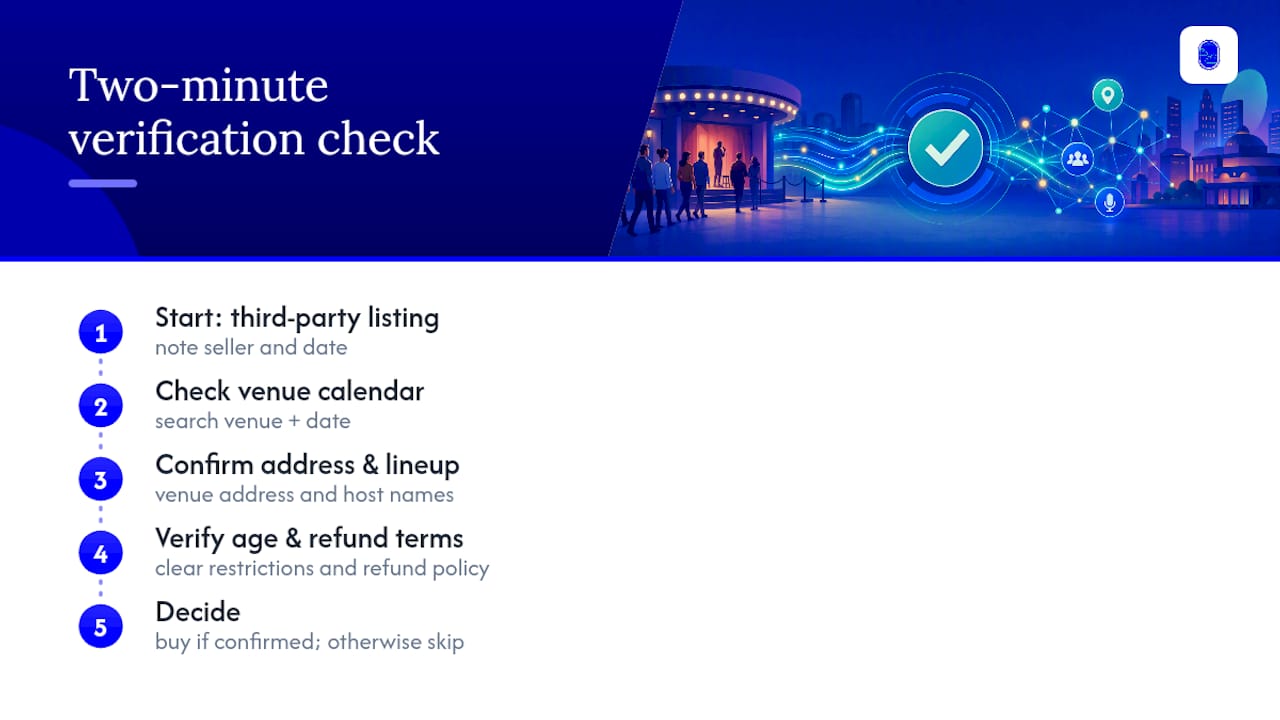
Reputable sources share a few traits. They list a specific address, not just a city. They name the lineup or at least the host. They spell out age restrictions and refund terms clearly instead of burying them in a support ticket queue. Venue calendars and box office pages remain the most reliable reference point precisely because they're the primary source, everything else is a copy of that listing, and copies can go stale or get scraped incorrectly.
Before buying from any marketplace or third-party listing, do a two-minute check: search the venue's name plus the date, see if their own site confirms the show, and look for a working phone number or box office email. If a "showcase" has no venue address listed anywhere, or the seller can't tell you who's headlining, skip it. Canceled or rescheduled shows also tend to vanish quietly from resale platforms without a clear notice, while venue calendars usually update the listing directly with a rescheduled date. That's another reason to treat the venue's own page as your tiebreaker whenever two sources disagree.
How can apps and alerts help you catch new comedy shows fast?
Comedy schedules move quickly, and the best lineups often sell out before they hit a general search. Turning on notifications is the difference between catching a great show early and finding out about it after it's gone.
Most venue websites let you opt into email alerts for new listings, and that's usually the first place a new date appears. Enable push notifications on any event platform you use regularly, including Experience By Locals, so new listings in your city surface the moment they're posted rather than a week later. Following venues and comedians directly on Instagram or Facebook adds a second layer: many pop-up shows and last-minute open mic slots get announced there first, sometimes just hours ahead.
A simple habit works better than any single app: check your saved venue calendars weekly, keep notifications on for one or two platforms you trust, and follow a handful of local comedians whose taste matches yours. That combination catches both the planned showcases and the spontaneous ones, without requiring you to constantly refresh five different sites.
Are there discounts or membership perks for regular comedy fans?
If you go to shows often, the cost adds up fast between tickets, fees, and drink minimums, so it's worth looking for ways to lower that per-visit cost. Many clubs quietly reward loyalty even without a formal program.
Ask about mailing list discounts directly. Venues frequently send subscriber-only presale codes or occasional two-for-one nights that never show up in a public listing. Some clubs offer a punch card or frequent-visitor perk, buy a handful of shows and get one free, though this varies a lot by venue and isn't always advertised outside the box office itself. Off-peak timing helps too: weekday and early showtimes are typically priced lower than weekend headliner slots, and that gap can be the easiest discount you'll find without hunting for a code.
Festival passes are worth a hard look if you attend more than a couple of shows a year. Paying for a multi-show pass upfront usually works out cheaper per set than buying single tickets to the same number of individual showcases, and it forces you to sample acts you wouldn't have picked otherwise. That's part of why festivals are such an efficient discovery tool, you're not just saving money, you're widening your exposure to comics you'd never have found searching one show at a time.
Why local-first search beats the algorithm every time
The conventional advice for finding comedy shows treats it like any other event search: open an app, sort by popularity, buy whatever's trending. That approach reliably surfaces the same touring headliners everyone already knows and just as reliably buries the fifteen-person room three blocks from your apartment where the next big voice in comedy is workshopping new material for free.
What the research here actually supports is a local-first sequence: venue calendars for accuracy, community platforms for discovery, marketplaces only as a last resort for confirming availability on names you already know. Marketplace algorithms are optimized to sell what's already popular, not to help you find what's genuinely good and nearby. That's not a knock on marketplaces, it's just not the job they're built to do.
If you take one thing from this, prioritize the sources closest to the artist and the room, not the sources closest to the checkout button. Grassroots showcases and open mics are where comedy's next wave actually gets built, and they're consistently the hardest shows to find through generic search. That's a gap worth solving before you default to whatever app shows up first.
— DJ
Ready to see what's playing near you tonight?
Big ticket marketplaces are great if you already know the headliner you want. Experience By Locals solves a different problem: finding the community comedy nights, open mics, and artist-run showcases that never make it onto a national ticketing app because they're too small, too local, or too new. You skip the resale markups and book straight with the host, which means your money supports the actual comedian and venue instead of a middleman.
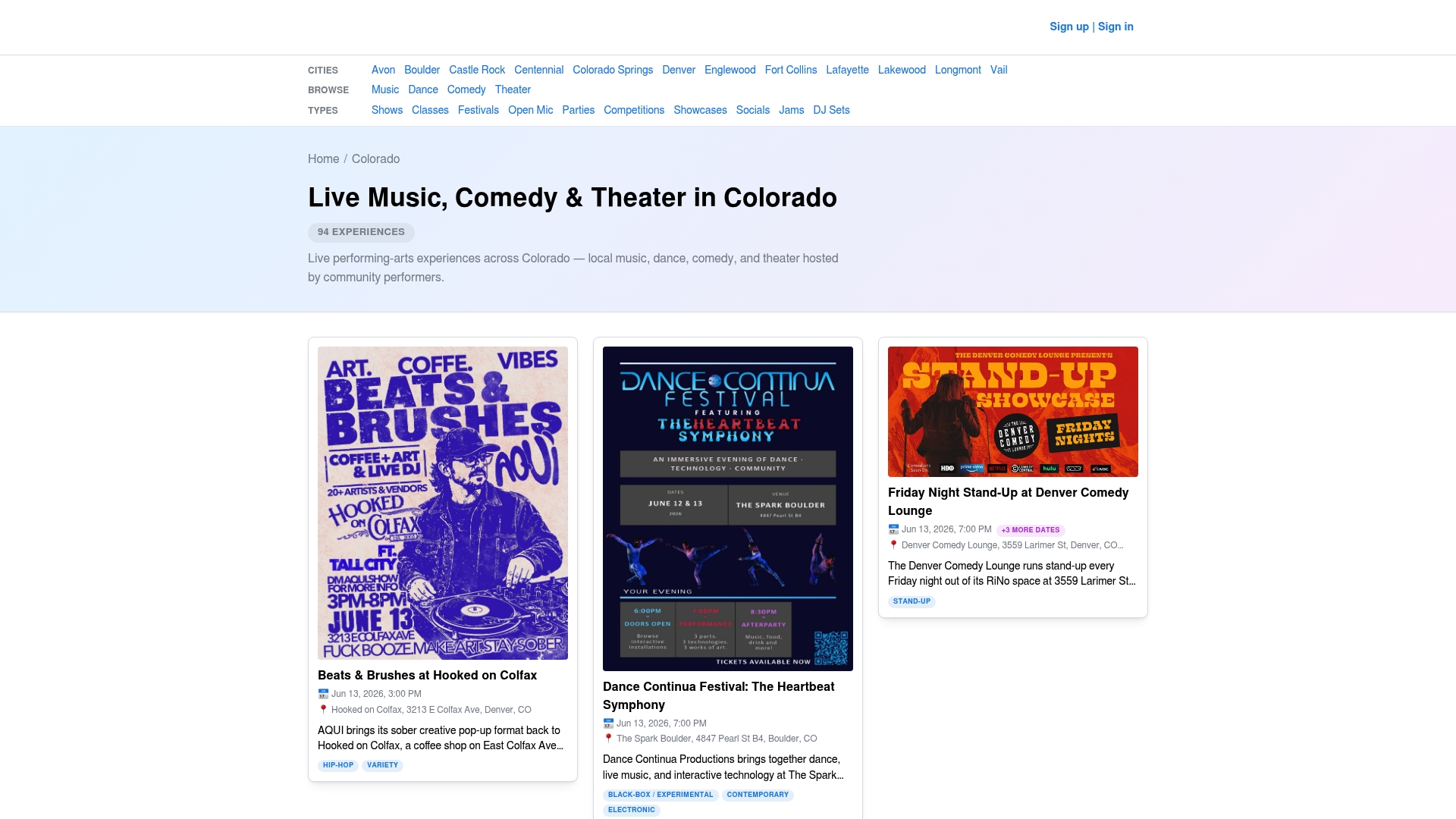
Search by city and date on our Colorado comedy listings to see what's playing this week, or browse the full statewide events page if you're open to a short drive for the right lineup. Bookmark it, turn on notifications, and check back weekly, new showcases get added constantly, and the best ones tend to move fast.
Sources
- Inaugural comedy festival features 50 acts and 150 performers | WyoFile
- Whats Funny Comedy Festival | Choose Chicago
- NYC Still Rising After 25 Years: A comedy celebration | Madison Square Garden
- Free Speech Project tracker — club policies summary | Georgetown University
- Comedy show at The Grisly Pear Greenwich Village — event listing