
Local Storytelling Is the Real Engine Behind Great Comedy

Local storytelling strengthens a joke's impact because specific, place-based detail creates instant recognition, sharper character voice, and a payoff that actually lands emotionally, not just mechanically. A comic who knows the exact bus route, the exact diner, or the exact regional insult builds trust with a room faster than one working in generic material. That trust is what turns a chuckle into a real laugh.
- Recognition: audiences lean in when they hear their own streets, slang, or grudges
- Texture: specific detail replaces vague description and does more comedic work per word
- Voice: local dialect and vernacular give a bit an authentic character
- Tribal confidence: performers from a community feel safer taking creative risks in front of it
A platform profile of Chicago comic Al Scorch found that reading the city's municipal code in an exaggerated local accent built him a devoted following, proof that even bureaucratic minutiae becomes comedy gold when it's your bureaucracy.
Key Takeaways
Local storytelling works because specific, place-based detail builds faster audience trust, richer character voice, and stronger emotional payoffs than generic material ever can.
| Point | Details |
|---|---|
| Specificity beats generality | Small, vivid local details create recognition and travel to universal feelings faster than broad references. |
| Test before you commit | Use open mics and crowd work to confirm a local reference lands before building a full bit around it. |
| Stage time is the lab | Consistent local stage time is the mechanism that turns raw local material into a polished set. |
| Identity material needs care | Reference communities you belong to and test whether laughs come from recognition or othering. |
| Find rooms built for it | Experiencebylocals lists community comedy nights where performers can list, test, and book local shows. |
Table of Contents
- What Is the Role of Local Storytelling in Comedy?
- Which Storytelling Techniques Turn Local Details Into Big Laughs?
- How Have Comedians Used Hometown Stories to Build a Following?
- How Do You Find and Test Local Material That Actually Works?
- Can Local Comedy Cross the Line Into Stereotyping?
- Why Does Stage Time at Local Venues Matter So Much?
- A Note From an ExperienceByLocals Contributor
- Ready to Test Your Local Material on a Real Stage?
- Sources
What Is the Role of Local Storytelling in Comedy?
The role of local storytelling in comedy is to compress the distance between performer and audience. A joke about your city's parking enforcement or your neighborhood's weird corner store does something generic material can't: it tells the room "I know exactly where you live," and that recognition primes them to trust the punch line before it even arrives.

This is why regional comedic styles persist even in an era of streaming specials built for global audiences. Community narratives in humor work because they draw on shared reference points that don't need explaining. A comic in Houston riffing on which taco truck closes too early doesn't need a setup; half the room already agrees. That shared agreement is doing comedic labor a stranger's material can't replicate.
Local humor development also solves a structural problem for newer performers. Original observational comedy is hard to generate from nothing, but a neighborhood, a commute, or a family tradition hands you raw material nobody else in the world has in quite the same shape. The trick is knowing what to do with it, which is where technique comes in.
Which Storytelling Techniques Turn Local Details Into Big Laughs?
Local material only pays off with the right mechanics behind it. Here's what separates a flat local reference from a bit that kills.
- Pace the setup tight, then let the local detail hit fast. A rambling description of your hometown kills momentum. Name the street, the store, the smell, in as few words as possible, then move straight to the turn.
- Build a distinct voice for local characters. Accent, cadence, and vernacular do more character work in five seconds than a paragraph of description. A grandmother's specific phrasing or a bus driver's exact complaint carries the bit.
- Start small and specific, then let the joke travel outward. The detail that feels narrowest, a specific pothole, a specific church potluck dish, is usually the one that unlocks a universal feeling everyone recognizes: frustration, embarrassment, nostalgia.
- Use crowd work as a live test. Ask the room a direct question about a local reference before you commit to the bit. Their answer tells you whether the reference is common knowledge or too narrow.
- Edit ruthlessly and escalate. Cut every word that doesn't earn its place, then look for one more turn, a tag, a callback, a second image, that pushes the local detail past its first laugh.
Scene reporting on San Antonio found that bilingual rhythms and neighborhood-rooted family stories create material that feels immediately intimate to local crowds, largely because the specificity does the emotional groundwork a broader joke would need three extra lines to establish.
Pro Tip: Write the local detail first, then write the joke around it. Comics who write the punch line first often bend the local detail to fit, and it reads as forced. Reverse the order and the material stays honest.

How Have Comedians Used Hometown Stories to Build a Following?
The clearest case studies come from comics who treated their own city as source material rather than backdrop. Al Scorch's municipal code project is the standout example: he read Chicago's actual civic ordinances in an exaggerated local accent and turned bureaucratic language, something audiences usually tune out, into a recurring bit that built a podcast around it. The lesson is that civic detail nobody else thinks is funny can become a signature if you commit to the bit fully enough.
- Chicago: municipal code and civic identity as comedic material, building sustained audience loyalty
- San Antonio: bilingual delivery and family-rooted storytelling producing intimate, immediately recognizable jokes
- Houston: a genuinely multicultural scene that pushes comics toward material that connects across communities while keeping neighborhood and food references intact
An ethnographic study of South Asian diasporic stand-up in Toronto adds a deeper layer here. Researchers found that self-deprecatory racial humor functions as reverse discourse, letting performers resist stereotypes while building resilient community spaces rather than reinforcing outsider assumptions.
The comedy did not simply reflect racial stereotypes back at the audience. It repurposed them, using self-deprecation as a tool for community resilience rather than a punch line at the community's expense.
What each example teaches is that selection matters more than volume. One well-chosen civic detail, one bilingual family joke, one identity-aware bit built with care, outperforms a set stuffed with local name-drops that never go anywhere.
How Do You Find and Test Local Material That Actually Works?
Turning your neighborhood into usable material follows a repeatable process, not a lightning-strike moment of inspiration.
- Inventory first. Spend a week writing down every local oddity you notice: a phrase your barber uses, a weird zoning rule, a rivalry between two blocks. Don't judge it yet, just collect it.
- Pick the ones with tension. The moments worth testing usually involve a contradiction, pride and embarrassment, love and annoyance, tradition and absurdity.
- Test at open mics before you commit stage time to it. Watch for a specific signal: does the audience laugh in recognition (they know the reference) or laugh in curiosity (they're learning something)? Both can work, but they need different framing.
- Apply a keeper test. One useful benchmark from reporting on developing local material: if a reference gets the same type of laugh across at least two local rooms and one non-local room, it's probably strong enough to keep in rotation.
- Edit for stakes and payoff. Tighten the setup, add a second beat or callback, and make sure the tag lands harder than the initial punch line.
- Adapt for out-of-town rooms without gutting the bit. The strongest approach is to keep one vivid sensory detail intact, the smell, the sound, the specific insult, and briefly explain the rest so outsiders can follow without the joke going flat.
Pro Tip: Keep a "translation line" ready for every local bit, a single sentence that explains the reference without killing the joke's rhythm. You'll need it the first time you play a room outside your city.
Can Local Comedy Cross the Line Into Stereotyping?
Yes, and it happens more easily than most performers expect. The most common failure modes are relying on lazy shorthand instead of real observation, treating an entire community as one joke, or writing insider references that exclude the very audience you're trying to connect with.
- Ask whether the joke targets a system or habit, or a group's existence
- Reference communities you belong to or have real standing to speak on, not ones you're observing from outside
- Test whether the laugh comes from recognition or from othering, they feel very different in the room
- When in doubt, reframe the target from "these people" to "this specific situation"
- Watch how platforming nights that showcase marginalized performers build the confidence needed to handle identity material responsibly
Why Does Stage Time at Local Venues Matter So Much?
Local stage time is the actual laboratory. Reporting on comedy scenes consistently finds that consistent stage time is the primary mechanism for developing material, and without it, local storytelling has nowhere to get tested, sharpened, or discarded.
- Open mics are for volume testing; showcases are for refining the bits that survived
- Audience composition shifts what lands, a college bar and a family-friendly room won't laugh at the same references
- Nights built specifically to platform underrepresented voices create the confidence for performers to push riskier, more specific material
- Seek out supportive local rooms rather than the biggest room in town first
A Note From an ExperienceByLocals Contributor
I once watched a comic at a community night turn a Boulder parking dispute into the best five minutes of the show, and the room recognized every beat. Pro Tip: find your rowdiest, most local room first. That's where the real material gets born.
Ready to Test Your Local Material on a Real Stage?
Every technique in this piece only matters once you get in front of a room, and Experiencebylocals exists to make finding that room easier than cold-emailing venues or hoping a booker notices you. Instead of chasing tourist-heavy clubs that reward generic sets, you get listed alongside grassroots shows built around the same community-first material this article just walked through.
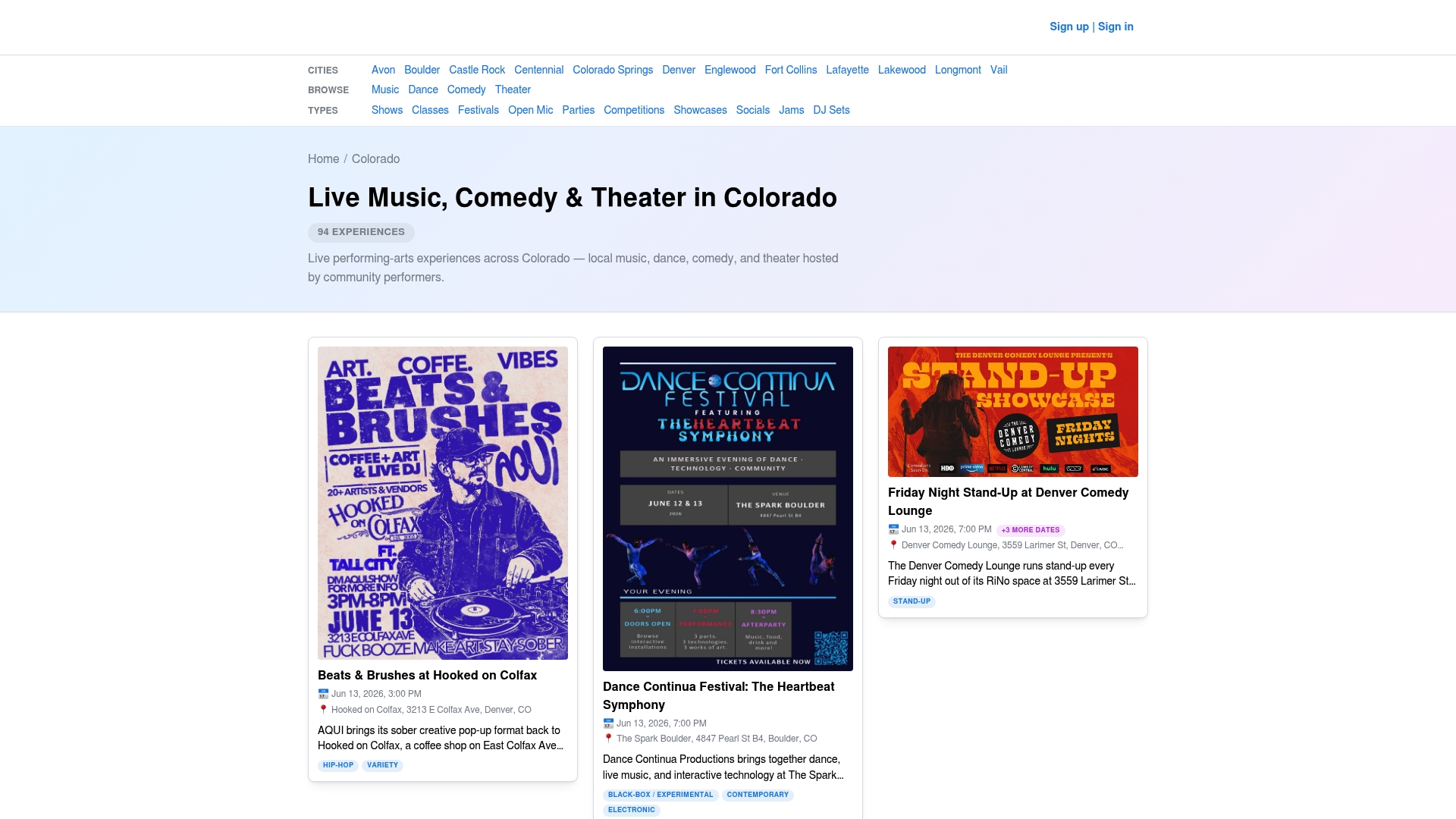
Performers can browse and list shows directly, connect with hosts running community-driven comedy nights, and find audiences already primed for local, specific, place-rooted material. If you're searching for a room to test new bits, start with comedy shows across Colorado or check listings like Friday Night Stand-Up at Denver Comedy Lounge to see how local hosts are already building the kind of audience this whole approach depends on. List your next set or book a seat in the crowd at experiencebylocals.com.
Sources
- Desi laughs and racial lives: an ethnographic inquiry of how South Asian diasporic stand-up comedy in Toronto mobilises racial humour as reverse discourse for resistance and resilience
- Chicago comic Al Scorch turns city's municipal code into laughs in new podcast
- How San Antonio’s culture shapes its comedy
- Cultivating local comedy: The power of stage time