
Why Attending Live Theater Matters for Your Community

Why attending live theater matters more than you think
Live theater is one of the most powerful tools we have for building empathy, strengthening community, and improving personal well-being. And the research backs this up fully. Three field studies with 1,622 participants found that attending a live play increased empathy, shifted socio-political beliefs, and led to higher charitable donations, even to causes unrelated to the performance. That is not entertainment. That is transformation.
Here is what live theater consistently delivers:
- Deeper empathy through immersive storytelling and character identification
- Social connection with strangers sharing the same room and the same story
- Cognitive engagement that sharpens social intelligence and emotional understanding
- Long-term well-being benefits confirmed by longitudinal research
- ️ Community cohesion across demographic and cultural divides
- Support for local artists and the broader cultural economy
How live theater builds empathy and social intelligence
The empathy effect from live theater is measurable and lasting. Researchers Steve Rathje, Leor Hackel, and Jamil Zaki found that audience members who felt emotionally transported by a performance, those who agreed with statements like "The play affected me emotionally," showed the strongest empathy gains and the most generous charitable behavior afterward.
"We found that after, as opposed to before, seeing the plays, audience members reported feeling more empathy for the groups of people depicted in the plays and changed their attitudes about political issues related to the plays. Additionally, seeing theatre changed people's behavior. After seeing the plays, people donated more to charity — whether or not the charity was related to the topics in the plays." — Steve Rathje, lead researcher
Children benefit just as concretely. Students who attended a live play scored higher on the RMET (Reading the Mind in the Eyes Test, a standard measure of social intelligence) compared to peers who read the same script or watched a recorded version. Live presence changes how deeply we process another person's inner world.
How theater builds community and bridges social divides
Theater scholar Russell Vandenbroucke, Professor of Theatre at the University of Louisville, puts it plainly:
A study at Actors Theatre of Louisville confirmed that regular attendance promotes flourishing, meaningful social interaction, and a shared sense of community, particularly at a time when that sense of community feels diminished across the United States. Focus groups in that same study noted a desire for audiences that better reflected the full diversity of their city, urban and rural, prosperous and not, across racial lines. Theater has the capacity to gather people who would not otherwise share a room.
Live theater promotes social cohesion in ways few other spaces can:
- ✅ It creates a shared experience across different backgrounds and life stories
- ✅ It opens space for civic dialogue on difficult social questions
- ✅ It builds a sense of belonging among both regulars and first-time attendees
- ✅ It connects local dance communities and performing arts audiences around shared cultural identity
- ✅ It counters isolation by placing people in a room with a common purpose
What makes the live theater experience unlike anything else
No algorithm can replicate what happens when a room full of people holds its breath together. The unpredictability of live performance is a feature, not a flaw. A laugh lands differently on a Tuesday than a Saturday. A pause after a heavy line can tighten the air in a way no replay preserves. Every performance is, by definition, a one-time event.

The neuroscience is striking. Research from the NEUROLIVE project at University College London and Goldsmiths found that audience brainwaves synchronize most intensely during live performances, less so in movie theaters, and least of all when people watch content alone at home. That synchrony is the biological signature of shared emotional experience. It builds trust, empathy, and a sense of belonging in real time.
Live theater also demands something increasingly rare: your full attention. Once the lights go down, there is no second screen, no pause button, no algorithm suggesting what to watch next. That concentrated presence is, for many people, a genuine relief.
Pro Tip: If you are bringing someone to their first live show, pay attention to their spontaneous reactions. Theater professionals often say that first-timers remind them why the art form matters, because those unguarded gasps and laughs are exactly the communal magic that keeps performers coming back.
Long-term personal and cultural benefits of going regularly
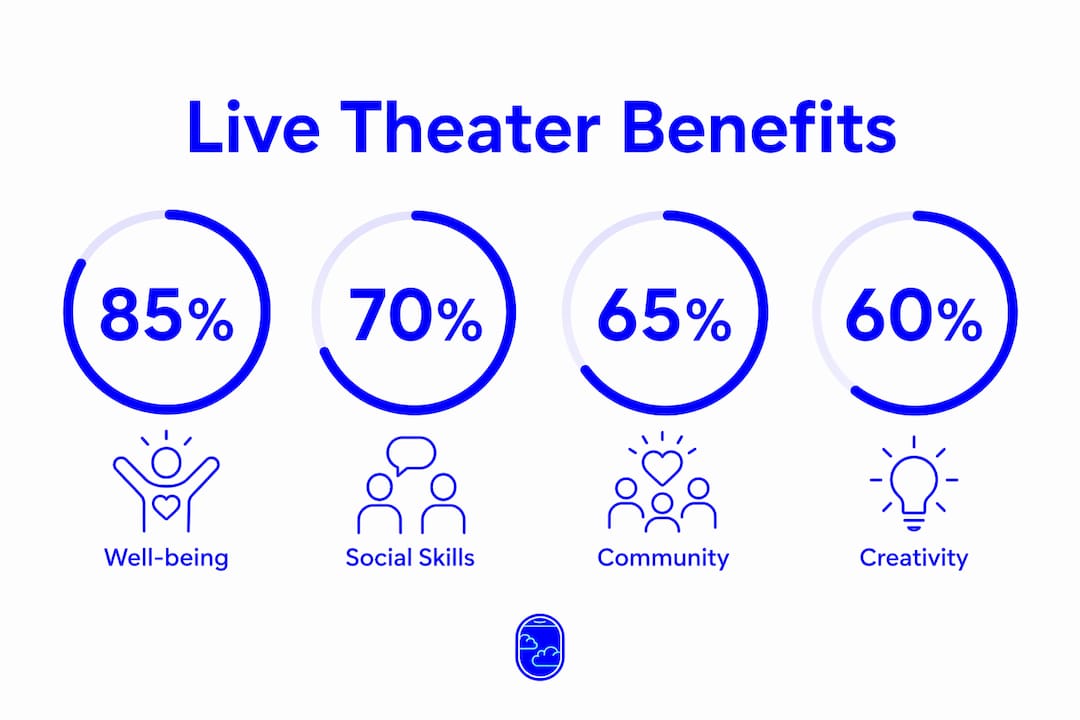
The benefits of attending live theater do not stop when the curtain falls. A two-year longitudinal study of 53 theater-goers aged 60 and older found that the cumulative positive affect experienced across multiple performances predicted measurable improvements in well-being over time. Social engagement, a sense of belonging, and the flow state achieved during performances all contributed to that outcome.
| Benefit | Research finding |
|---|---|
| Improved well-being | Two-year study of older adults linked regular attendance to sustained well-being gains |
| Empathy and attitude change | Three field studies with 1,622 participants showed increased empathy and charitable giving |
| Social intelligence in children | Live attendees scored higher on the RMET than peers who read or watched recorded versions |
| Community cohesion | Louisville study confirmed theater builds shared identity across demographic divides |
| Local economic support | Live theater sustains regional artists and businesses that streaming cannot replace |
Younger audiences gain especially strong psychosocial benefits, including flow, social engagement, and a sense of belonging, and those benefits grow even further when involvement extends to volunteering and philanthropy linked to theater.
Direct benefits you feel from attending a live performance
Sitting in a theater does something to you that a couch and a screen simply cannot. Your mood lifts. Your stress eases. A UK government study found positive mental and physical health benefits associated with the performing arts, including improved cognitive function and reduced stress. The emotional catharsis of watching a powerful scene, processed in a room full of people feeling the same thing, is a genuine psychological release.
Theater also sparks creativity. Exposure to diverse stories and characters encourages you to think differently, consider new perspectives, and carry that imaginative energy into everyday life. For many people, a single night at the theater opens a door to a way of seeing the world they had not considered before.
The historical and cultural significance of live theater
Theater is one of humanity's oldest communal practices. From the Theatre of Dionysus in ancient Athens, where citizens gathered to wrestle with questions of justice, fate, and identity, to Lorraine Hansberry's A Raisin in the Sun making history on Broadway in 1959 as the first play by a Black woman produced there, live performance has always been where culture asks its hardest questions out loud.
Oscar Wilde called theater "the greatest of all art forms, the most immediate way in which a human being can share with another the sense of what it is to be a human being." That has not changed. What has changed is the urgency. As playwright Larissa FastHorse wrote in American Theatre, "You wanna remember why you do theatre? Do a show full of audiences who have never been to theatre before. Hearing gasps and cheers at the magic of theatre, it's incredible and addictive."
The cultural significance of theater extends beyond the stage. It preserves regional stories, gives local artists a platform, and keeps cultural energy circulating within communities rather than flowing outward to national platforms.
Real live theater in Colorado, hosted by local artists

If this article has you ready to experience what we have been describing, Experiencebylocals is your direct path to authentic local performances across Colorado. We are not a streaming platform or a tourist venue. We are a community-built space where local artists host real shows, from theater and comedy to live music and dance, for audiences who want genuine connection over packaged entertainment.
Whether you are looking for theater shows in Colorado or want to browse everything happening near you, Experiencebylocals puts grassroots talent front and center. You get to support the artists who live in your community, discover performances that reflect your city's actual cultural heartbeat, and walk away with the kind of shared experience this article is all about. Check out what is happening near you and grab your spot at a local show.
Key takeaways
Live theater builds empathy, strengthens community, and improves well-being in ways that longitudinal research and field studies consistently confirm across all age groups.
| Point | Details |
|---|---|
| Empathy and behavior change | Three studies with 1,622 participants showed theater increases empathy and charitable giving. |
| Brain synchrony | Audience brainwaves sync most intensely during live shows, creating shared emotional states. |
| Long-term well-being | A two-year study of 53 older adults linked regular attendance to measurable well-being gains. |
| Cultural and civic value | Theater sustains local artists, local economies, and community identity that streaming cannot replace. |
| Experiencebylocals | Connects Colorado audiences to authentic local theater and live performances by grassroots artists. |