
Improv Jams in Denver: How to Join In or Just Watch

An improv jam is an open, drop-in night of improvised comedy where anyone in the room can sign up, get called to the stage and play a scene with people they may have just met. In Denver, jams run in comedy theaters, community spaces and recovery-focused arts programs, and most are free or low cost. You can walk in as a first-timer, a seasoned performer who needs more stage time, or a curious neighbor who only wants to laugh from a seat. 🎭
We are Experience By Locals, a Colorado platform for local live comedy, music, dance and theater. Here is how jams work, how to pick one that fits you, and how to make your first night a good one.
TL;DR
- An improv jam is like an open mic for improvisers: you sign up, get called up in a small group and play short scenes, usually with no experience required.
- You can absolutely come just to watch. Jams are built around community, so audience members are part of the night.
- Denver jams range from weekly late-night comedy theater sessions to free daytime community jams, so check each host's page for the current schedule before you go.
- Arrive early, put your name on the list, say yes to your scene partners and expect a few bumpy moments. That is part of the fun.
- Browse local comedy, improv workshops and open mics in one place on Experience By Locals.
Table of Contents
- What an improv jam actually is
- What happens on a jam night
- Who can join
- Where and when to find jams in Denver
- What it costs
- Your first jam: a simple playbook
- For performers: why jams are worth your time
- For audiences and visitors: why jams are worth a night out
- Find your next stage on Experience By Locals 🔎
- Etiquette that keeps jams fun
- FAQ
- Sources
What an improv jam actually is
Improv (short for improvisation) is theater and comedy made up on the spot, with no script. A jam is the loosest, friendliest version of it. The Improv Resource Center's wiki describes a jam, sometimes called a mixer, as a performance where any attendee is invited to take part, much like an open mic, and notes these nights are often free or low cost and organized to build community or help people learn.
That is the key difference from a regular improv show. A show has a set cast that rehearsed together, a lineup and a ticket. A jam has a host, a sign-up sheet and a room full of people who all want to play. Some of the best nights are the ones where experienced performers share a stage with someone who took their first class last week.

A quick note on the word "jam": in Denver you will also see movement-based jams, such as contact improvisation for dancers. Those are about dance, not comedy, and have their own community. This guide is about comedy and theater improv jams. If you are a dancer, our Colorado dance listings are a good place to start.
What happens on a jam night
Every host runs things a little differently, but most jams follow the same rhythm:
- Doors and sign-up. You arrive, find the host and write your name on the list. Many jams use a simple sheet of paper.
- Warm-ups. The host often leads a few quick games so people loosen up and learn each other's names.
- Groups get called. According to the IRC Improv Wiki, participants are typically called up in groups of roughly 5 to 9 for about 5 to 10 minutes of stage time, sometimes with total strangers.
- Scenes happen. The host may offer a suggestion from the audience, such as a location or a word, and the group builds scenes from it.
- Rotation. Another group is called, and the cycle repeats until the night wraps up.
The same source points out that big theaters in other cities use late-night jams hosted by repertory performers to give students extra stage time. That tells you something useful about the format: it is as much a practice space as a performance. Nobody expects polish.
Can you watch without performing?
Yes. Jams are designed to be open, and many hosts welcome people who come just to see what it is like. Watching a night or two is a smart way to learn the room's tone, see how the host moves people on and off stage, and decide whether you want to put your name down next time. Audience members also matter more than they realize: a warm, laughing crowd makes every scene better for the people on stage.
Who can join
Most jams welcome anyone, including people with no team and no training. Colorado Artists in Recovery, for example, describes its Denver-area improv jam as a low-pressure space with absolutely no experience required, led by veteran local improvisers and free to attend with registration.
Still, jams are not all identical, so it helps to know the common types:
- Beginner-friendly community jams. Low pressure, often free, hosted by a local performer or organization. Great for a first visit.
- Late-night theater jams. Hosted by regular performers at comedy venues, usually drawing a mix of students and experienced improvisers.
- Team jams. Established teams or groups try new formats or play with guest performers. You might see these listed as team jams.
- Drop-in classes. A short, structured session where an instructor teaches while you play. If a jam feels like too big a first step, a drop-in class can be a gentler on-ramp. Our improv workshops in Colorado listings are a good place to look.
If you are under 18, check the host's age policy first. Many comedy venues serve alcohol and set age limits, and our guide to teen open mics in Denver covers stages that welcome younger performers.
Where and when to find jams in Denver
Denver's improv scene is spread across comedy theaters, small independent stages, community arts groups and pop-up nights hosted by local performers. Some jams run weekly on a set evening, some run monthly, and some move locations. Because schedules, rooms and rules change, treat any date you read in an article as a starting point and confirm it on the host's own page before you head out.
Here is a practical way to search:
- Start with local comedy listings. Browse live comedy in Denver and look for improv, jam, drop-in and open-mic labels.
- Check open mics. Many hosts blend formats. Our comedy open mic listings are worth a look if you want a stage and are open to stand-up or sketch as well as improv.
- Look at venue pages. Local rooms such as Denver Comedy Underground show what is coming up in one place.
- Search community programs. Arts nonprofits sometimes host free jams during the day or on weekends, which can feel calmer than a late-night bar room.
- Ask at your first jam. Improvisers love to share where else they play. One night often leads to three more.
Expect weeknight evenings to be the most common slot, with start times between roughly 6:30 and 8 p.m. in many local listings, and some late-night sessions after a show. Weekend daytime jams exist too, especially in community programs.
Denver neighborhoods and getting there
Many of Denver's comedy rooms sit in or near the central neighborhoods, so a jam is often an easy ride from downtown, LoDo, RiNo or Capitol Hill. If you are driving, plan for evening parking, and if you are coming from Boulder or the suburbs, give yourself extra time on weeknights. Arriving 20 to 30 minutes early is smart anyway, since sign-up often happens before the show begins.
What it costs
Improv jams are among the most affordable live comedy experiences in the city. The IRC Improv Wiki notes jams are often free or low cost, and community jams in Denver commonly follow that pattern: free to watch, free or inexpensive to play. Some venues ask you to buy a drink or a small ticket, and drop-in classes are typically a modest paid session. Exact amounts change by host and season, so look at the event page for the current price.
A few things you usually do not need:
- A team or partner
- Prior classes
- Props or costumes
- A prepared bit
What you do want: a valid ID if the venue serves alcohol, a little cash or a card for a drink or tip, comfortable clothes you can move in and a willing attitude.
Your first jam: a simple playbook
First-timers often worry about being funny. The good news is that jams reward something easier: paying attention to the person next to you.
- Go once as an audience member. Notice how the host runs the list, how long scenes last and what the crowd responds to.
- Arrive early and sign up. Introduce yourself to the host and say it is your first time. Hosts usually appreciate knowing and will often set you up with a supportive group.
- Say yes. The core improv habit is accepting what your partner offers and building on it. If someone says you are a pirate, you are a pirate.
- Listen more than you plan. The best lines come from what just happened, not from what you prepared.
- Let the bumps happen. Backstage's improv guide says to expect the experience to be nerve-wracking and exhilarating, to stay flexible with your scene partners and to accept that some jokes will fall flat. One actor it quotes describes pacing nervously before every show and then wanting to go again.
- Cheer for others. The fastest way to feel part of the group is to support everyone else's scene.
- Come back. Improv gets easier with repetition. Your second jam will feel very different from your first.
If you are a performer looking to build a bigger schedule, our guide on how to get gigs in Denver shows how local artists turn open stages into regular bookings.
For performers: why jams are worth your time
If you already perform, jams are a low-risk way to get reps. You can test a new character, practice a format or meet scene partners outside your usual circle. For stand-up comics and sketch writers, a jam sharpens listening and quick thinking, skills that carry straight into other kinds of stage work. Actors from the theater world use them to loosen up too.
They also build relationships. Many Denver teams, shows and side projects start with two people who happened to land in the same group on a Wednesday night. Show up regularly, be generous on stage and the invitations tend to follow. When you are ready to step up to a showcase, look at comedy showcases in Denver.
For audiences and visitors: why jams are worth a night out

If you are visiting Denver or new to town, a jam shows you the city's comedy community the way few other things can. You see neighbors, students, teachers and longtime locals trying things in real time. No two nights are the same, and you leave with a story. It is a very different experience from a tourist-heavy venue, and usually a lot cheaper.
Watching is also a gentle way to find your people. Many regulars started out as spectators who got curious.
Our take on improv jams
We built Experience By Locals around a simple belief: the most memorable nights out in Colorado come from people who live here and make things here. Improv jams are a perfect example. They are not polished productions. They are rooms full of neighbors giving each other a chance.
That is why we focus on local talent and grassroots stages. A jam asks for very little from you: show up, be kind, play. In return, you get a taste of what makes Denver's creative community tick, whether you are on stage or in the third row.
If you are a performer, we hope you use jams as a stepping stone. Start with a jam, move to an open mic, try a showcase, then host something of your own. If you are a guest, we hope you let a jam surprise you. Bring a friend, laugh loudly and say hello to the people next to you.
We love hearing how people find their first stage. Tell us yours.
DJ
Find your next stage on Experience By Locals 🔎
When you want one place to browse local comedy, improv workshops, open mics and more, Experience By Locals is a searchable platform for live music, dance, comedy and theater hosted by community artists across Colorado. You can filter by what you are in the mood for and book directly with event hosts.
Start with live performances in Denver or explore the full range of comedy shows in Colorado.
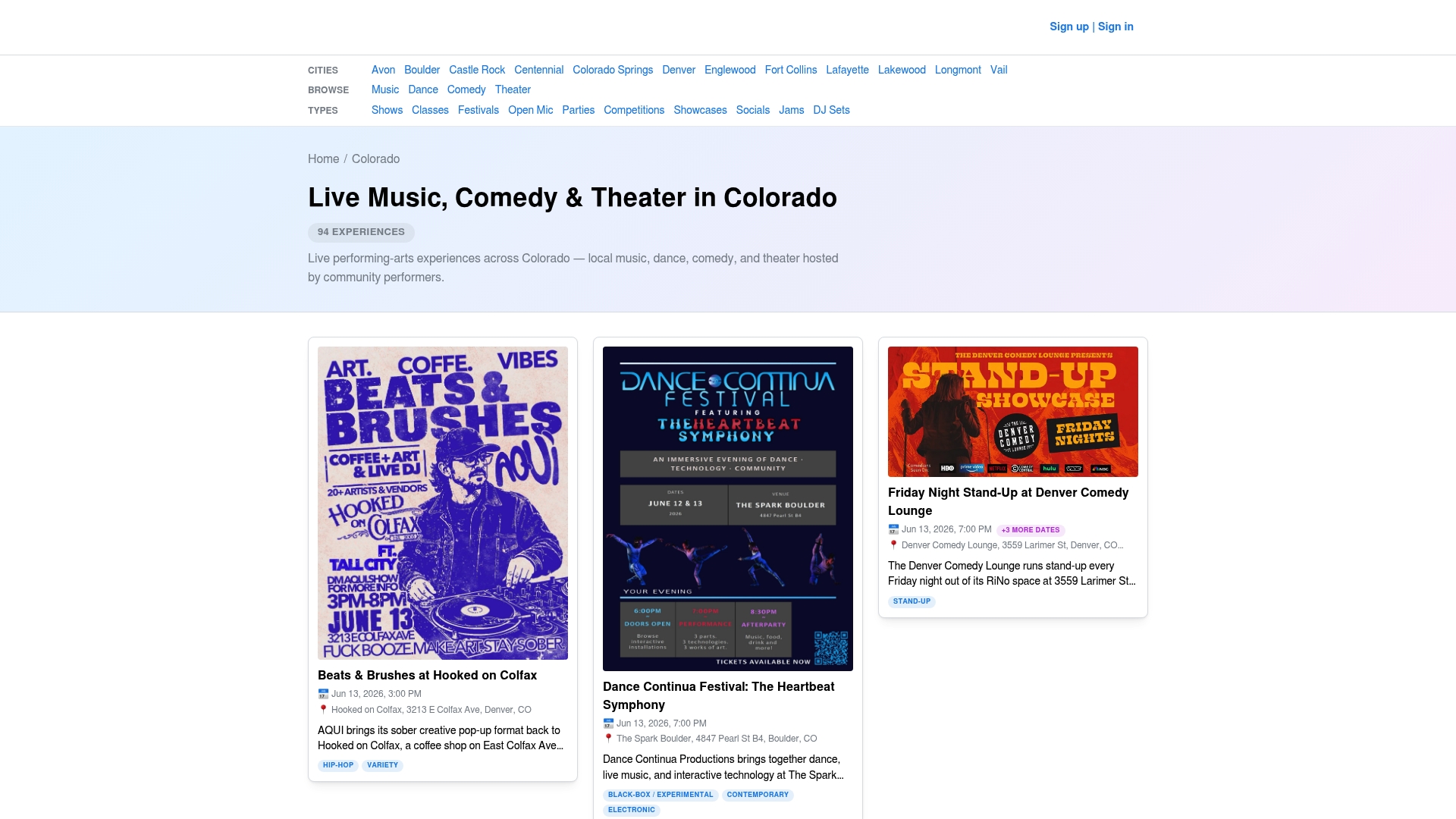
If stand-up is more your speed after a few jams, browse stand-up events in Colorado too. Theater fans in northern Colorado can also check the theater open mic in Fort Collins.
Etiquette that keeps jams fun
A few shared habits make every jam better for everyone:
- Be on time for sign-up. Late arrivals can miss the list.
- Respect your scene partners. Do not steer a scene away from someone or put them in an uncomfortable spot.
- Keep it kind. Punching up, not down, keeps the room welcoming. If a scene is going somewhere a partner is not comfortable with, change direction.
- Watch the whole night. If you perform, stay and support the others.
- Tip your host and support the venue. Jams are often run by volunteers or on a shoestring.
- Follow the host's rules. Phones, recording and content limits vary from room to room.
FAQ
Do I need experience to join an improv jam in Denver?
No, many jams are open to complete beginners. Some, like community jams for artists, state outright that no experience is needed. If you feel nervous, watch once first or start with a drop-in class, then sign up when you feel ready.
Can I just watch an improv jam?
Yes. Jams are open events and audiences are welcome. Check the host's event page for any cover charge, drink minimum or age limit before you go.
How much does an improv jam cost?
Jams are typically free or low cost, with community-run nights often free to watch and play. Prices and drink requirements vary by host and change over time, so confirm the amount on the current event listing.
How long will I be on stage?
At many jams, groups of about 5 to 9 people are called up for roughly 5 to 10 minutes, according to the IRC Improv Wiki. Depending on how many people sign up, you might play once or a few times.
What should I bring?
Bring a valid ID if the venue serves alcohol, a little money for a ticket, drink or tip, and comfortable clothes. You do not need props or a prepared bit.