
How to Get Gigs in Denver: A Performer's Practical Guide

To get gigs in Denver, start on open mic stages, build real relationships with the people who run rooms, apply to city programs and festival calls when they open, and send every booker one short, complete packet. Most first bookings come from showing up, being easy to work with, and making the next yes simple. This guide walks through each step, with the specifics Denver performers ask us about most.
A quick note on the search itself: if you type this phrase into Google, you mostly get delivery and temp-work listings. We're talking about the other kind of gig here: a stage, a set, an audience. 🎤 Musicians, comedians, dancers and actors are all welcome.
TL;DR
- Open mics are the fastest way in. They are where you test material, meet bookers and find collaborators.
- Denver Arts & Venues runs a paid street-performer roster and issues festival calls. Both have application windows, so check the official pages for current dates.
- One complete packet (short bio, photos, video or audio, gig history, contact details) beats ten half-finished emails.
- Before you say yes, confirm the rate, payment timing, set length, load-in and equipment in writing.
- List your own shows on a local platform so audiences and bookers can find you between gigs.
Table of Contents
- Start on the open mic circuit 🎯
- Build relationships, not just a list of emails
- Apply to Denver's paid programs and festival calls
- Build one application packet that does the work
- How to pitch a Denver venue or organizer
- Before you say yes: pay, terms and logistics
- Prepare for the practical side
- Put your shows where Denver audiences look
- A simple plan for your first three months
- FAQ
- Sources
Start on the open mic circuit 🎯
If you have no gig history in Denver, an open mic is your doorway. 303 Magazine's Denver open mic guide frames these nights as more than low-stakes stage time: they are places to cultivate collaborators, test material and reach new audiences. The same guide points to recurring nights in a mix of venues, from comedy-and-music rooms to cafes and bars, and notes that Facebook groups and online calendars carry the up-to-date listings. Rooms change their nights often, so confirm before you travel.
What works at an open mic:
- Go once as a guest first. Watch how the host runs the list, how long sets are, and who the regulars are.
- Sign up on time and respect the clock. Hosts remember the performer who finishes on time and thanks the sound person.
- Stay for the whole night. The relationships you build in the room are worth more than the five minutes on stage.
- Bring something to hand out or a way to follow you. A QR code to your page or a card is enough.
- Say yes to the invitation after. Hosts and fellow performers often pass along a feature spot or a spot on their own show.
We keep a running list of open mics across Colorado, and if hip hop is your lane, our guide to finding a Denver hip hop open mic helps you avoid a wasted trip. Singer-songwriters can browse singer-songwriter events in Denver to see what rooms are active and what a typical bill looks like.
Match the stage to your art form
Different art forms get booked in different ways, and it helps to know which door to knock on.
| Art form | Good first stage | What bookers want to see |
|---|---|---|
| Music | Open mics, songwriter nights, showcase bills | Live video, a few streaming links, a realistic draw |
| Comedy | Open mics, bringer shows, showcases | Tight five to seven minutes, clip of a real set |
| Dance | Community events, artist-run spaces, festivals | Short performance reel, clear space and tech needs |
| Theater | Community productions, readings, festival slots | Resume, headshot, a clip or reference |
For comedians, browsing a comedy showcase in Denver is a good way to see which shows book new voices and what the host's style is before you ask for a spot.
Build relationships, not just a list of emails
Bookers get dozens of cold messages. The ones that land usually come from someone they already know. In an interview with a Denver booking professional, the advice was to attend shows, form genuine relationships with artists and venue staff, and take part in the local community, as described in this Underground Music Showcase conversation.
In practice that looks like:
- Pick three or four rooms that fit your sound or style and go regularly.
- Learn the names of the booker, the sound engineer and the door person.
- Support other acts on the bill. Buy a ticket, share the show, stay for the headliner.
- Ask what the room needs: a opener on a slow night, a last-minute fill-in, a themed show.
- Follow up within a day or two with a short thank-you and one link.
Artist-run spaces deserve special attention. They are often more open to new performers and experimental formats, and they are where many community-driven shows start. Our local's guide to artist-run venues in Denver explains how to find them and how to approach them respectfully.
Apply to Denver's paid programs and festival calls
When you are ready for paid, scheduled work, Denver has official routes worth knowing.
The 16th Street Performers Network
Denver Arts & Venues runs the 16th Street Performers Network, which accepts individual artists and ensembles of up to three performers in any genre, including musicians, visual artists and craft demonstrators. Applications are reviewed quarterly. A few details that save you disappointment:
- Acceptance is not a hiring guarantee. The Downtown Denver Partnership selects, contracts and pays artists for specific activations.
- Roster membership lasts two years, after which you reapply.
- The current rate listed is $150 per performer per performance hour, with payment due within 30 days.
- Performances generally happen between 10 a.m. and 9 p.m., and the performance agreement spells out location, timing, limitations and requirements.
Because the program updates its details, read the official page before you apply.
Festival calls for performers
City festivals post calls for performers, and the format is a useful template for what to expect. The 2024 Five Points Jazz Festival call accepted musician applications through November 30, asked for one-hour performances plus one hour for load-in and soundcheck, and said lineup decisions would begin in late January. The pattern is the lesson: festival applications open months before the event, and decisions come well ahead of the date. Watch the Denver Arts & Venues news page for the current year's calls, and keep your packet ready so you can apply the week a call opens.

Build one application packet that does the work
A complete, easy-to-open packet is the single most useful thing you can prepare. Booking professionals consistently ask for the same ingredients:
- A short bio (two or three sentences, plus a one-line version)
- High-resolution photos, with credit and permission to use
- Music samples, a comedy clip, a dance reel or a scene from a show
- Live-performance video, because bookers want to see you in front of a crowd
- Gig history and any press quotes
- Contact information that is easy to find
- A stage plot or technical rider if you need specific gear or space
The goal is that a booker can understand who you are, what you do and how to reach you in about two minutes. We lay out the full structure in our guide to one application packet that lands calls for performers in Colorado.
Video is the part most performers underinvest in. If you are a musician with a song but no strong visual, ready-made music videos can give your press kit and social posts something polished to show. If you want to see how other artists put visuals to work, these artist success stories are a good place to start. Either way, a clean live clip filmed at a real show still tells bookers the most.
How to pitch a Denver venue or organizer
A good pitch is short and specific. Here is a structure that works for a first message:
- Who you are. One sentence with your name, art form and a credential or two.
- Why this room. Mention a show you attended or a bill you'd fit. This is the line that shows you did your homework.
- What you're asking for. A specific slot or date range, not "anytime."
- Your link. One link to your packet or a live video.
- How you'll help fill the room. Your audience size, your mailing list, the people you'll invite and how you'll promote.
- How to reach you. Email and phone.
A sample opening for a musician:
Hi Sam, I'm a Denver folk duo and I've been coming to your Tuesday songwriter night since the spring. We'd love a 30-minute opening slot on a weeknight in the next two months. Here's a live video and our one-page packet. We'll promote to our local list and bring friends. Thanks for considering us.
Notice what is missing: long life story, ten links, apologies. Keep it to the point and send it at a reasonable hour, then follow up once after a week or so. If you hear nothing, go to the next show and say hello in person.
Before you say yes: pay, terms and logistics
A gig that goes badly usually goes badly in the details nobody talked about. Confirm these before you accept:
- Pay structure. Flat fee, door split, tips only or ticket percentage? Ask what counts as the door and when you get paid.
- Payment timing. For the 16th Street program, payment is due within 30 days. Other organizers have their own timelines, so ask.
- Set length and load-in. Include soundcheck. The Five Points call, for instance, counted an hour for load-in and soundcheck on top of the performance.
- Equipment. What is provided, what you bring, and whether there is power.
- Promotion. What the venue will do and what they expect from you.
- Cancellation. What happens if the show is canceled or the weather turns.
- A written confirmation. Even an email thread stating date, time, pay and set length protects both sides.
For money and contract questions, local education helps. Music First offers musician education on EPKs, contracts, getting booked, sound equipment and festivals, and advocates for fair pay. The organization reports having put more than $35,000 directly into musicians' pockets through its events and partner events.
Prepare for the practical side
Good preparation is what gets you rebooked. If you are playing outdoors or on the street, the 16th Street guidelines are a useful checklist even for other venues:
- Plan for locations without power, so battery-powered gear may be necessary.
- Use only approved equipment.
- Don't block pedestrian or business access.
- Keep amplified sound within the current 50 dB noise restriction.
For indoor shows, add a few habits: arrive early, label your cables, bring spare strings, sticks or batteries, have a printed set list, and send a short advance note to the sound person. For dance and theater, send your space, floor and lighting needs in advance.
For promotion, give the venue a ready-to-post image, a two-line description and your handles at least a few weeks ahead. Then actually post. Bookers notice who helps fill the room.
Our perspective
We built Experience By Locals because we kept hearing the same two stories. Artists said they had the talent but no clear path to the right stage. Audiences said they wanted real local shows but kept landing in tourist-heavy places.
Here is what we believe about getting gigs in Denver: the scene runs on community. Open mics, artist-run spaces, comedy nights and neighborhood shows are where performers and audiences actually meet. When you list your shows where people are already searching for local live music, comedy, dance and theater, you stop relying on one booker's reply and start building a visible track record. That record is exactly what the next booker wants to see.
Our platform lets guests browse and book events directly with the hosts, so the people who create the culture are the ones who benefit from it. We are proud to champion grassroots talent, and we'd love to see you on the stage or in the audience.
DJ
Put your shows where Denver audiences look
Between gigs, visibility matters. Experience By Locals is a searchable platform for live music, comedy, dance and theater hosted by local artists and creators across Colorado. Guests browse and book directly with event hosts, and you can see what your scene looks like right now by exploring live performances in Denver.
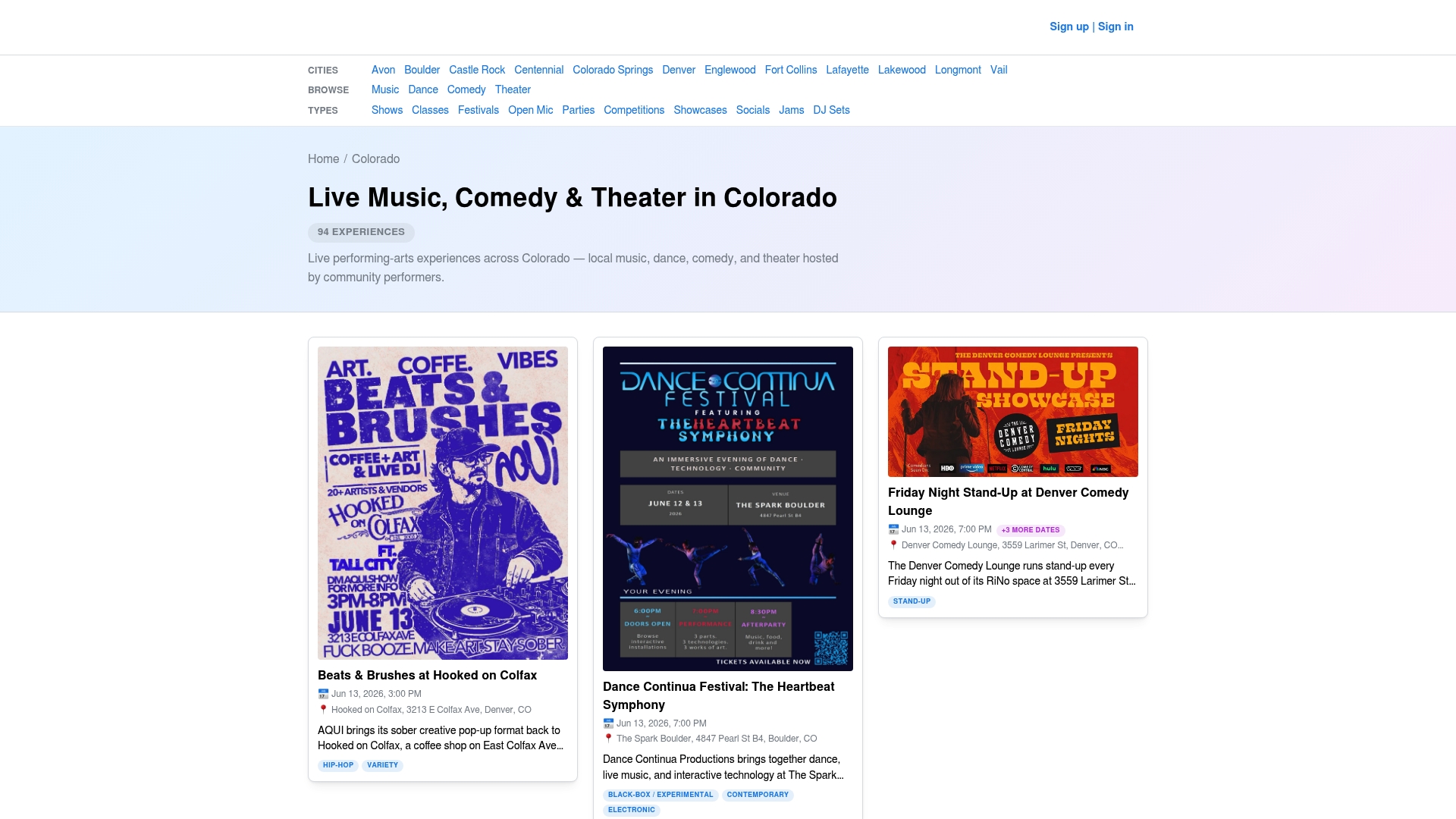
Whether you are looking for a room to learn from or hoping to host your own event, start with live music, comedy, dance and theater in Denver. Seeing who is booking what is the quickest way to find the rooms that fit you. 🤝
A simple plan for your first three months
You don't need to do everything at once. Here is a steady rhythm many performers can sustain:
Month one: show up. Attend at least one open mic or showcase a week. Perform at two of them. Collect names and follow people you meet.
Month two: get ready. Finalize your packet, film a live set, and refresh your photos. Check the official Denver Arts & Venues pages for open calls and application cycles.
Month three: ask. Send five short, specific pitches to rooms where you already know the staff. Apply to any open call that fits. Offer to help promote and follow up once.
Then repeat, with a little more confidence each cycle. Every gig you play becomes the proof for the next one.
FAQ
How do I get my first gig in Denver with no experience?
Start with open mics and showcases, where nobody expects a track record. Go as a guest first, then sign up, meet the host and ask about a feature spot after you've performed a couple of times. Film one live set so you have something to share.
Do Denver venues pay performers?
It varies by venue and event type. Some pay a flat fee, some split door revenue, and some offer tips only. The 16th Street program lists $150 per performer per performance hour, so check the official page for current terms, and always confirm pay and timing before you accept.
What should I send when I contact a booker?
Send a short message with who you are, why you fit their room, a specific date range, one link to your best live video and your contact details. A packet with a bio, photos, samples and gig history helps them decide quickly.
Can comedians and dancers get gigs the same way as musicians?
Yes, the approach is the same: show up, build relationships, share a clear clip and pitch specifically. Comedy has plenty of open mics and showcases, and dancers often find opportunities at community events, artist-run spaces and festivals.
Where do I find out about open calls for performers?
Watch Denver Arts & Venues for city programs and festival calls, and use Facebook groups and online calendars for open mics and local shows. Our Colorado open mic listings are another place to look.
Sources
- 16th Street Performers Network, Denver Arts & Venues
- Arts & Venues applications for the 2024 Five Points Jazz Festival
- Open Mics In The Mile High, 303 Magazine
- Behind the Lineup: Underground Music Showcase
- Music First