
4 Denver Alternatives to MAS Presents and How Locals Find Them

If you're looking for MAS Presents alternatives in Denver, the real answer is a mix of formats: sober all-ages DIY spaces, underground sound-system venues, curated session series, and house concerts or pop-ups that never make it onto mainstream calendars. Community calendars, venue Discord channels, and Experience By Locals' Denver listings are your fastest routes to finding them. We'll walk through what each format looks like, how to vet a show before you show up, and where to find the next one.
TL;DR:
- Denver's grassroots music scene relies on diverse formats like DIY spaces, underground venues, curated sessions, and private house shows, each appealing to different audience interests.
- Finding these shows requires checking community calendars, social media accounts, record-store boards, and experience platforms to avoid relying solely on mainstream ticketing sites.
- Many grassroots venues operate with slim margins and lack profitability, emphasizing community support through attendance, volunteering, and word-of-mouth promotion to sustain the scene.
- Experience By Locals offers a centralized platform to filter and book local underground shows by neighborhood and genre, saving time from manual searching.
- Regulations still apply to grassroots shows, especially occupancy limits and noise rules, with private house concerts needing careful consideration of legal boundaries.
Table of Contents
- What alternatives look like in Denver: a concise catalog of venue and promoter types
- How to find and vet Denver's grassroots shows: a practical checklist
- Why these grassroots alternatives matter: Denver's cultural and economic context
- How Experience By Locals helps Denver fans find and book these alternatives
- Legal and regulatory considerations for grassroots music events in Denver
- Profiles of notable alternative venues or organizers
- History and origins of MAS Presents and its impact on the local music scene
- Comparison of MAS Presents with each alternative (strengths and weaknesses)
- How to get involved or contribute to grassroots alternatives
- Local curator perspective on the importance of grassroots spaces
- Experience By Locals as your next step for finding these shows
- Sources
- FAQ
What alternatives look like in Denver: a concise catalog of venue and promoter types
Denver's grassroots music scene runs on a handful of formats, and once you know what they look like, you'll spot them everywhere from flyer walls to Instagram stories.
DIY, sober, and all-ages spaces sit at one end of the spectrum. Local reporting on Ante Up describes it as a sober, all-ages venue built around punk, hardcore, and emo shows, often priced on a donation or sliding scale rather than a fixed cover. These rooms tend to draw a younger, tight-knit crowd that treats the space as much as a community hub as a stage.
Underground, sound-system-focused venues sit at the other end. The Black Box runs as a dual-room underground space built around sound quality first, hosting electronic, bass, hip-hop, and experimental shows. If you care about how a set actually sounds and not just who's playing, this is the category to chase.
Curated session series occupy a middle ground between concert and happening. The Gypsy Lab Sessions rebuilds an older local model into a monthly production with a live band backing rotating local artists, plus extras like live painters and tarot readers woven into the night. These shows reward people who want an experience, not just a setlist.
Then there are house concerts, invite-only pop-ups, and mixed-use community arts spaces, the most unpredictable and often the most rewarding category.
- DIY sober spaces: best when you want an all-ages, low-pressure night built around punk, hardcore, or emo.
- Underground sound-system venues: best when sound quality and bass-heavy genres matter more than the lineup name.
- Curated session series: best when you want a full creative experience, not just a band on a stage.
- House concerts and pop-ups: best for intimate nights, often smaller crowds and closer artist access, though you'll need an invite or RSVP.
Knowing which category fits your mood on a given Friday makes the rest of the search a lot easier.
How to find and vet Denver's grassroots shows: a practical checklist
Grassroots shows rarely show up on the big ticketing sites, so the hunt takes a slightly different approach than buying a stadium ticket.
Start with these channels, in roughly this order of usefulness:
- Community calendars and Denver Arts & Venues feeds, which surface citywide arts programming alongside independent shows.
- Venue-specific Instagram and Discord accounts, where promoters like The Black Box post set times and last-minute changes.
- Record-store bulletin boards, still a reliable analog source for house shows and one-off pop-ups that never get a digital listing.
- Experience By Locals' Denver listings, which let you filter by neighborhood, genre, and all-ages status in one search.
Pricing norms vary by format. Sober DIY spaces often run on donation or sliding-scale pricing, underground venues typically charge a modest cover at the door, and curated sessions may sell advance tickets because seating or capacity is limited. Some shows are pre-RSVP only, especially house concerts and pop-ups, so check whether you need to reserve a spot before showing up with cash in hand.
Before you commit a night to an unfamiliar venue, run through a short vetting checklist: confirm the age policy and whether it's labeled sober or all-ages, look for a posted code of conduct, check whether the venue mentions its sound or PA setup, and see whether the organizer has a public social account with real engagement rather than a blank page. These small signals tell you a lot about how a night will actually go.
Pro Tip: Follow two or three promoters directly on Instagram rather than relying on one aggregator. Underground listings often drop with less than a week's notice, and promoter stories move faster than any calendar.
First-time attendees should also plan for basics: cash for cover or donation boxes, comfortable footwear for standing-room venues, and a ride plan since many DIY spaces sit outside the areas well served by late-night transit.
Why these grassroots alternatives matter: Denver's cultural and economic context
Independent stages aren't a nostalgia act. They're a measurable piece of Denver's economy, and they're also financially fragile.
Independent live entertainment in Denver generates $192.7 million in annual off-site spending, yet only 25% of independent stages report profitability, according to NIVA's State of Live report. That gap between economic contribution and financial stability is the whole story: these venues fill hotels, restaurants, and rideshares around them, while the venues themselves often run on thin margins.
Denver Music Strategy, the report from Denver Arts & Venues, calls for more all-ages DIY and mixed-use venues along with cross-sector partnerships to keep the ecosystem alive. That's a direct response to the fragility NIVA documents: without policy support and community buy-in, the rooms that develop new artists and anchor neighborhood identity are the first to close.
Grassroots venues also do something a big promoter rarely can: they give emerging artists a stage before they're ready for a 2,000-seat room, and they give neighborhoods a cultural identity that outlasts any single tour. Many of these spaces run on volunteer crews and unpredictable funding, which means showing up, paying the cover, and telling a friend about a show is a genuine act of support, not just a night out.
How Experience By Locals helps Denver fans find and book these alternatives
Finding these shows manually across a dozen Instagram accounts and bulletin boards works, but it's a lot of legwork for a Tuesday night decision. A platform like Experience By Locals can bring that search into one place.
There are platforms listing searchable live music, dance, comedy, and theater events across Colorado, often hosted directly by local artists and creators rather than pulled from a mainstream ticketing feed. In Denver specifically, such platforms may offer filters by neighborhood, genre, and all-ages status to help narrow choices, host-managed listings that keep information current, and options for direct booking or RSVP to streamline event attendance.
To try it, start with the Denver listings page, search by the genre or neighborhood you're curious about, and follow a few host pages to catch new listings as they go up. If you want to browse beyond Denver, the Colorado music page covers the statewide picture, useful if you're planning a trip to Boulder or Fort Collins too.
Legal and regulatory considerations for grassroots music events in Denver
Grassroots shows still have to answer to the same basic rules as any public gathering, even when they feel informal.
Venues hosting live music need to comply with Denver's occupancy limits and fire code, which cap how many people a room can safely hold and often dictate exit access. All-ages and sober venues, including spaces like Ante Up, generally avoid liquor licensing entirely by not serving alcohol, which simplifies compliance but doesn't remove the need for basic safety planning. Venues that do serve alcohol need a state and local liquor license, and noise ordinances apply regardless of format, especially for shows running late into the evening in residential-adjacent neighborhoods.
House concerts and pop-ups in private residences occupy a gray area: they're generally treated as private gatherings rather than commercial events, but charging admission or serving alcohol can change that classification. If you're hosting rather than attending, it's worth checking with the City and County of Denver's licensing office before charging a cover or serving drinks at a private show, since the line between a private party and a licensed event depends on specifics that a quick call can clarify.
None of this is legal advice, just a reminder that "grassroots" doesn't mean "unregulated." The organizers running these spaces long term are usually the ones who've done the paperwork.

Profiles of notable alternative venues or organizers
A few names come up again and again once you start tracking Denver's independent scene.
Ante Up has built its reputation as a sober, all-ages space centered on punk, hardcore, and emo, with a pricing model that leans on donations rather than a fixed door charge. That combination makes it one of the more accessible entry points for younger fans or anyone who wants a night out without alcohol in the room.
The Black Box takes a different approach, built specifically around sound quality across its dual rooms, with programming that leans electronic, bass-heavy, and experimental. It's the venue to check if you care as much about how a show sounds as who's on the bill.
The Gypsy Lab Sessions occupies its own niche, rebuilding an older local model into a monthly production that pairs a live house band with rotating local artists, alongside extras like live painters and tarot readers. It's less a concert and more a curated night out, and it draws a crowd looking for that fuller experience.

Each of these fills a different need, and none of them try to be everything at once, which is part of why they've lasted.
History and origins of MAS Presents and its impact on the local music scene
MAS Presents has operated as one of several independent promoters shaping Denver's live music calendar, working alongside the city's broader network of DIY venues, underground rooms, and curated series rather than competing with them. Its programming has contributed to the same ecosystem that NIVA and Denver Music Strategy describe: a patchwork of independent stages that collectively support local artists and draw audiences away from purely mainstream touring circuits.
The broader impact of promoters like MAS Presents is best understood as part of Denver's larger independent stage network, one that the city's own arts agency has flagged as economically significant but financially precarious. Rather than any single promoter defining the scene, it's the density of options, DIY spaces, underground venues, curated sessions, and independent promoters together, that gives Denver its reputation as a city where grassroots music thrives.
Comparison of MAS Presents with each alternative (strengths and weaknesses)
MAS Presents functions as a promoter, booking and curating shows, which puts it in a different lane than venues like Ante Up or The Black Box that are tied to a specific physical space and identity.
Compared to a sober, all-ages venue like Ante Up, a promoter-driven model offers more flexibility in genre and venue choice but less of the consistent community identity that a dedicated space builds over time. Compared to a sound-focused venue like The Black Box, a promoter's strength is range across genres, while a dedicated venue's strength is depth in one lane, in this case, sound quality for electronic and bass music.
Against a curated series like The Gypsy Lab Sessions, the trade-off is experience versus access: a session series builds a specific, repeatable creative format night after night, while a promoter's calendar tends to vary more show to show. None of these formats is strictly better, they solve different needs, and the right pick depends on whether you want reliability of experience, depth in one genre, or breadth across many.
How to get involved or contribute to grassroots alternatives
Grassroots venues run on more than ticket sales, and there are real ways to pitch in beyond just showing up, as seen in genre-specific, community-managed spaces like Doom Scroll Amsterdam.
Volunteering is often the easiest entry point. Many DIY and sober spaces rely on volunteer door staff, sound techs, and setup crews, and reaching out directly through a venue's social account is usually enough to get considered.
Hosting is the next step up for anyone with a suitable living room, garage, or backyard. House concerts and pop-ups depend on people willing to open their space, and Experience By Locals' house concert guide covers what that looks like in practice for Denver hosts.
Promoting costs nothing but effort: sharing a show, tagging a venue, or simply bringing a friend helps small organizers who don't have a marketing budget. Given that only a minority of independent stages report profitability, per NIVA's data, that kind of unpaid word of mouth carries real weight for the venues trying to stay open.
Local curator perspective on the importance of grassroots spaces
The first time I stumbled into a Black Box show, I didn't know a single name on the flyer. I stayed because the sound system did something I hadn't heard in a bigger room. That's the case for grassroots spaces: they reward curiosity, not just loyalty to a headliner.
I check community listings and follow a handful of promoters directly, because the best nights rarely show up on a mainstream calendar. Support these rooms while they're still here.
*— DJ
Experience By Locals as your next step for finding these shows
Once you know what to look for, Experience By Locals turns that knowledge into a quick search instead of a scavenger hunt. Instead of juggling five Instagram accounts and a bulletin board photo, you get one searchable platform covering live music, dance, comedy, and theater across Colorado, run by the local artists and hosts themselves.
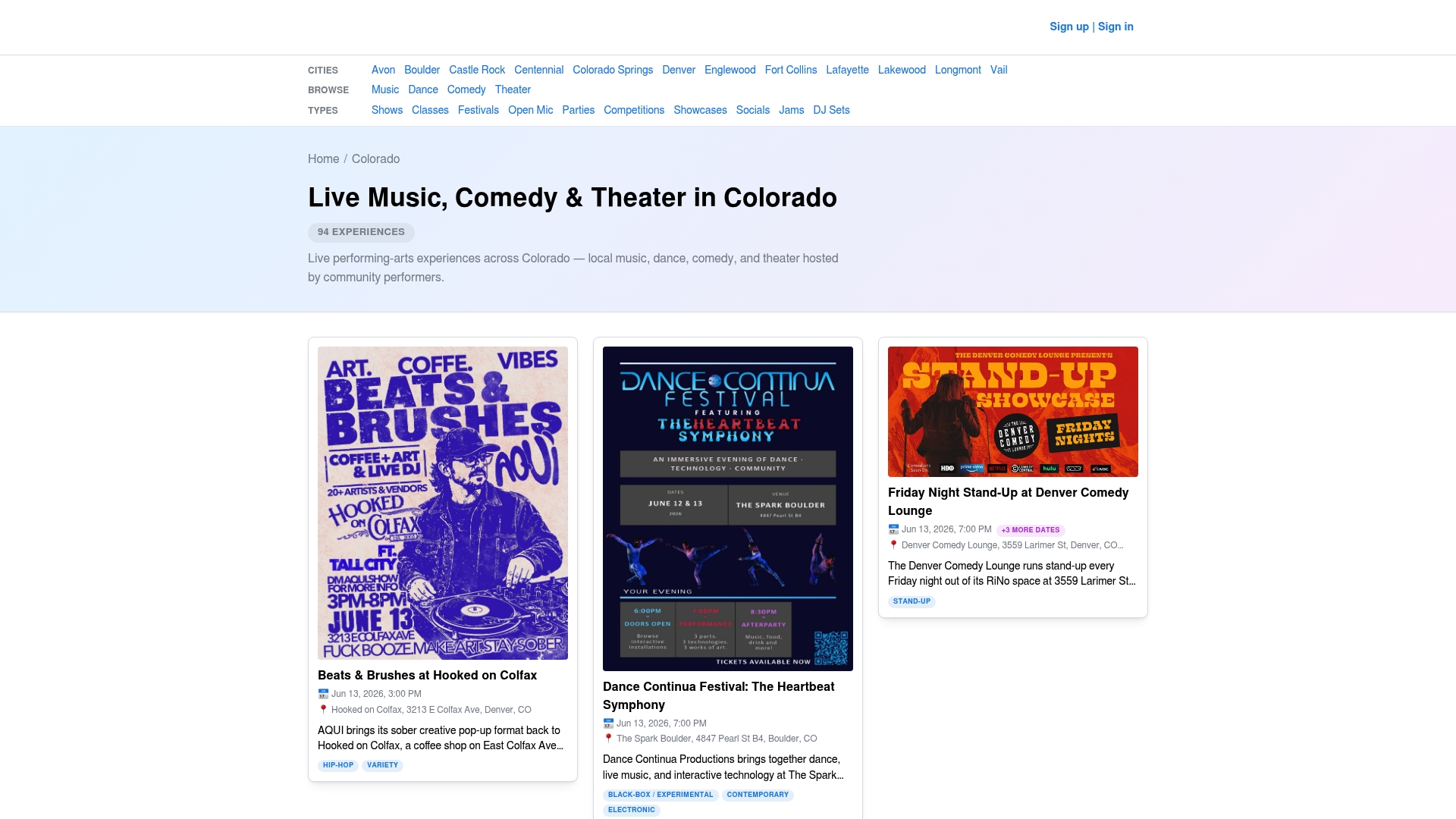
That matters most for anyone new to Denver's underground scene or short on time to track down every promoter's account. Whether you're chasing a sober all-ages punk show, a sound-system night, or a curated session series, the Denver listings page lets you filter by neighborhood and genre in one place. Browse the current listings, follow the hosts who match your taste, and book your next night out directly on Experience By Locals.
Sources
- NIVA's State of Live report — Denver
- Ante Up Denver DIY punk venue (Westword)
- The Black Box Denver | Home of the underground
- Gypsy Lab Sessions rebirth (Color Coded Magazine)
- Denver Music Strategy (Denver Arts & Venues)
FAQ
Is there a good music scene in Denver?
Yes, Denver supports a dense network of independent venues, DIY spaces, and curated series alongside its mainstream touring circuit. Reporting from NIVA's State of Live shows these independent stages generate $192.7 million in annual off-site spending for the city.
What bands are playing in Denver today?
Lineups change nightly across dozens of independent venues and pop-ups, so there's no single fixed answer. Checking platforms like Experience By Locals' Denver listings or venue-specific social accounts is the most reliable way to see what's on tonight.
Who are some popular Denver-based musicians?
Denver's scene spans genres from punk and hardcore acts that play sober DIY spaces to electronic and bass artists who headline underground venues like The Black Box. Rather than a fixed list, the artists worth tracking tend to be the ones building a following through repeat appearances at spaces like Ante Up or session series like The Gypsy Lab Sessions.
Is Denver a music city?
Denver's reputation as a music city rests heavily on its density of independent stages and grassroots venues, not just its larger touring rooms. Reports from Denver Music Strategy point to all-ages DIY and mixed-use venues as central to sustaining that identity long term.