
DIY Music Venues in Denver: Where the Underground Plays

Denver's DIY music venues are volunteer-run, community-owned rooms where the music comes first and the money comes second. Most are all-ages, most run on donations, and most are sober spaces. Seventh Circle Music Collective, D3 Arts, Ante Up and The D.M.V. are the names to start with. Here is what makes these places different, how they keep the lights on, and how you can walk in as a welcome guest or ask for a slot as a performer.
TL;DR
- 🎸 DIY venues in Denver are artist- and volunteer-run spaces, often all-ages and alcohol-free, with shows funded by suggested donations at the door.
- 📍 Good starting points are Seventh Circle Music Collective in Sun Valley, D3 Arts in Westwood, Ante Up on S Platte River Dr and The D.M.V. on E 43rd Ave.
- 🤝 Come early, bring cash for the donation, respect the house rules, and treat the neighborhood as a guest would.
- 🎤 Artists usually get shows by connecting with the community first, not by emailing a booking agent.
- 🔎 Our Denver live music listings help you find local shows and book directly with the hosts.
Table of Contents
- What “DIY” means in Denver
- Four spaces worth knowing
- How the shows get made
- Who you'll meet there
- Why the scene feels fragile
- How to show up respectfully
- Find your next local night
- Our perspective
- FAQ
- Sources
What “DIY” means in Denver
DIY stands for “do it yourself.” In music, it means the people who play the shows also build the space, run the door and clean up afterward. No promoter sits in the middle.
Denverite describes Denver's DIY art spaces as places that act as homes, studios and performance venues for local, usually young musicians, sometimes in warehouses or houses. They take donations during shows to help pay rent, they typically don't sell alcohol (people can bring their own), and they welcome all ages.
Westword's 2025 guide to the city's DIY punk rooms adds that these spaces are generally sober, queer-friendly and inclusive, with free or donation-based concerts. Pierre Booth of the band Dry Ice put the values simply in that piece: a good DIY venue centers the music and makes art accessible.
So compared with a conventional club, you should expect:
- A suggested donation instead of a fixed ticket price
- Little or no alcohol, and a crowd that spans teenagers to longtime locals
- No elevated stage, no backstage, sometimes no soundcheck
- Volunteers instead of staff
That last point matters. At Rhinoceropolis, the long-running Brighton Boulevard space, Westword reported that there were no employees, no riders and no set ticket prices. Shows were staffed by tenants and friends, and bands were paid from door donations.
Four spaces worth knowing
There is no official list of DIY venues, and the scene shifts as rents and leases change. These are the rooms that recent reporting keeps returning to.
Seventh Circle Music Collective
Seventh Circle, at 2935 West Seventh Avenue in Sun Valley, has been a volunteer-led, all-ages, sober venue since it took over the former Blast-O-Mat space in 2012. Westword reports that shows run on suggested donations plus a $5 yearly membership. Booth called it almost single-handedly responsible for keeping DIY alive in the city.
The lineup is wide. Rocky Mountain PBS reports that Seventh Circle hosts noise, hardcore, punk, metal, psych folk and country. You can see what's coming up on our Seventh Circle Music Collective page.
D3 Arts
D3 Arts, at 3632 Morrison Road in Westwood, is a nonprofit that mixes music, art and skateboarding. According to Westword, it took its current form in 2020, about 90% of its shows are all-ages, and its mission centers on community health and the Westwood area's Mexican heritage. Rocky Mountain PBS notes that it hosts drag shows, noise sets and art shows, and prioritizes people of color and cultural intersections.

Ante Up
Ante Up is one of the newest names. Westword reported in April 2026 that the space at 2130 S Platte River Dr is run by about 30 volunteers. Guests pay a suggested donation, which can be discounted if you bring a material donation for another nonprofit. It's all-ages and sober. Its first event, in January 2026, drew about 300 people and collected 200 food items for the Action Center of Lakewood.
That's a good picture of the scene's spirit: a punk show that doubles as a food drive.
The D.M.V.
The D.M.V. at 2424 E 43rd Ave is one of the city's newest experimental-music spaces. Denverite reports it officially opened in 2025 in a former marijuana grow and rave venue, and that it pays $4,000 a month in rent and doesn't turn anyone away for lack of funds. It sits inside a nonprofit called Solid State Arts, created by founder Davidoff.
Davidoff says a real sound system and stage, rather than a living room, makes it easier for performers and audiences to take part in noise-making. Rooms that blur the line between a gallery and a stage also raise questions about what music suits the space, and art gallery music is one way to think about that.
House shows and one-off spaces
Some of the best nights happen in living rooms, basements and garages. They rarely publicize addresses widely, and they change often. The best way in is to go to a few venue shows, meet people and ask. Don't expect to find them through a search.
How the shows get made
DIY rooms run on volunteers and shared trust.
Westword explained in 2014 that at the warehouse level, bands book themselves through personal connections with other DIY communities, not through promoters or booking agents. Door money generally goes straight to touring bands. Larger venues, in turn, use the DIY scene as a feeder for finding new acts.
A 2013 Westword piece described how tenants in live-in spaces do unpaid work: booking, providing sound equipment, staffing the door, cleaning up and hosting out-of-town bands. In exchange, they control what art gets shown.
As a guest, that translates to a few simple things:
- Your donation is the ticket. It pays the band and the rent.
- The person at the door is a neighbor and a volunteer, not a bouncer.
- The room is shared, so you help keep it tidy.
When it scales up: Blucifer
The same ethos shows up at festival scale. Westword reports that the 2026 edition of Blucifer's First Rodeo, an entirely artist-run four-day festival, showcased 259 local acts at 17 independent venues and businesses, plus 17 house shows and five DIY venues. Bands at official venues were paid at least $500, solo and duo acts at least $300, and house-show profits went to the musician-run nonprofit Holy Fool.

Co-founder Mike Young said the festival runs on everyone having fun together. If you're curious about festivals closer to the indie end of the dial, browse our Denver indie festival listings.
Who you'll meet there
The scene is not one genre. Rocky Mountain PBS reports that Denver's DIY world is increasingly showcasing LGBTQ+ music and art. Seventh Circle's Denver Underground Pride Fest drew more than 400 people in 2023, believed to be its biggest event since 2012, and mixed comedy, pop, noise and punk.
That mix is the point. A night might include a hardcore band, a drag performer and a stand-up set. If you love comedy, dance or theater as much as music, DIY spaces are often where those worlds overlap.
Here is a rough guide to what to expect by type of room:
| Type of space | Typical vibe | Usual cost | Good for |
|---|---|---|---|
| Volunteer-run collective | Punk, hardcore, metal, folk, noise | Suggested donation, small membership | First-timers who want a steady calendar |
| Arts nonprofit | Music, drag, art shows, skating | Donation-based or low cost | Community-minded nights |
| Experimental room | Noise, electronic, avant-garde | Donation, no one turned away | Curious listeners and performers |
| House show | Intimate, word of mouth | Donation | People already connected to the scene |
Why the scene feels fragile
If you've heard that Denver's DIY spaces come and go, you've heard right.
Rocky Mountain PBS reports that the 2016 Ghost Ship fire in Oakland, which killed 36 people, prompted nationwide crackdowns on spaces that weren't up to code, including Denver institutions like Rhinoceropolis. Stricter permitting and rising rents squeezed the scene. Westword reported in 2019 that Rhinoceropolis reopened and show requests picked up right where they left off, while Seventh Circle, in a code-compliant garage space, kept going.
Money is the other pressure. Booth told Denverite that Denver's rising cost of living has a snowball effect: people can't afford houses, so house venues disappear. Davidoff says raves and punk shows are what actually make money.
The wider independent scene faces the same squeeze. The National Independent Venue Association's June 2026 report, funded in part by Denver Arts and Venues, found independent live entertainment generates $1.5 billion in total economic output and supports 9,641 industry jobs in Denver, yet only 25% of independent stages reported profitability.
What that means for you: every donation, every membership and every friend you bring is a real contribution.
How to show up respectfully
This is the part nobody writes down, so here is our take, based on how these spaces describe themselves.
As an audience member
- Bring cash for the donation. It's how the band and the room get paid. If you can't pay, venues like The D.M.V. say no one is turned away.
- Honor the space. Many rooms are sober and inclusive by design. Leave the drinking and the attitude outside.
- Ask before filming or posting. Some spaces and performers prefer privacy, especially at house shows.
- Know the exits. Look for the way out when you arrive. Fire safety is why many spaces were shut down, and it is basic good sense in any packed room.
- Help clean up. A few minutes at the end goes a long way for volunteers.
As a neighbor
- Keep noise down as you leave, and don't linger on the sidewalk or in the street.
- Park thoughtfully and don't block driveways.
- Remember that the people running the space live and work nearby too.
As an artist
- Show up first. Go to several shows, say hello and be a regular before you ask for a slot.
- Support other bands. Westword's reporting shows that bookings run on personal connections, so being a good scene citizen is your best pitch.
- Be ready to pitch in. Load in, help with the door, stay for the whole night.
- Be clear about your sound. A noise set, a folk duo and a hardcore band each fit different rooms. Pick the right one.
- Think about volunteering. The volunteer-run model means every hand counts, and it's the fastest way to learn how a room works.
If you want to see where other local artists are playing before you reach out, our guide to indie music venues in Denver, neighborhood by neighborhood is a good map.
Find your next local night
We built Experience By Locals so that finding genuine local entertainment doesn't mean wading through tourist-heavy listings. Our platform lists live music, dance, comedy, theater, open mics, classes and cultural events across Colorado, hosted by community artists and creators. You can browse, filter and book directly with the hosts.
Start with our live music listings in Denver, or look at indie shows in Denver if you want something smaller and more homegrown.
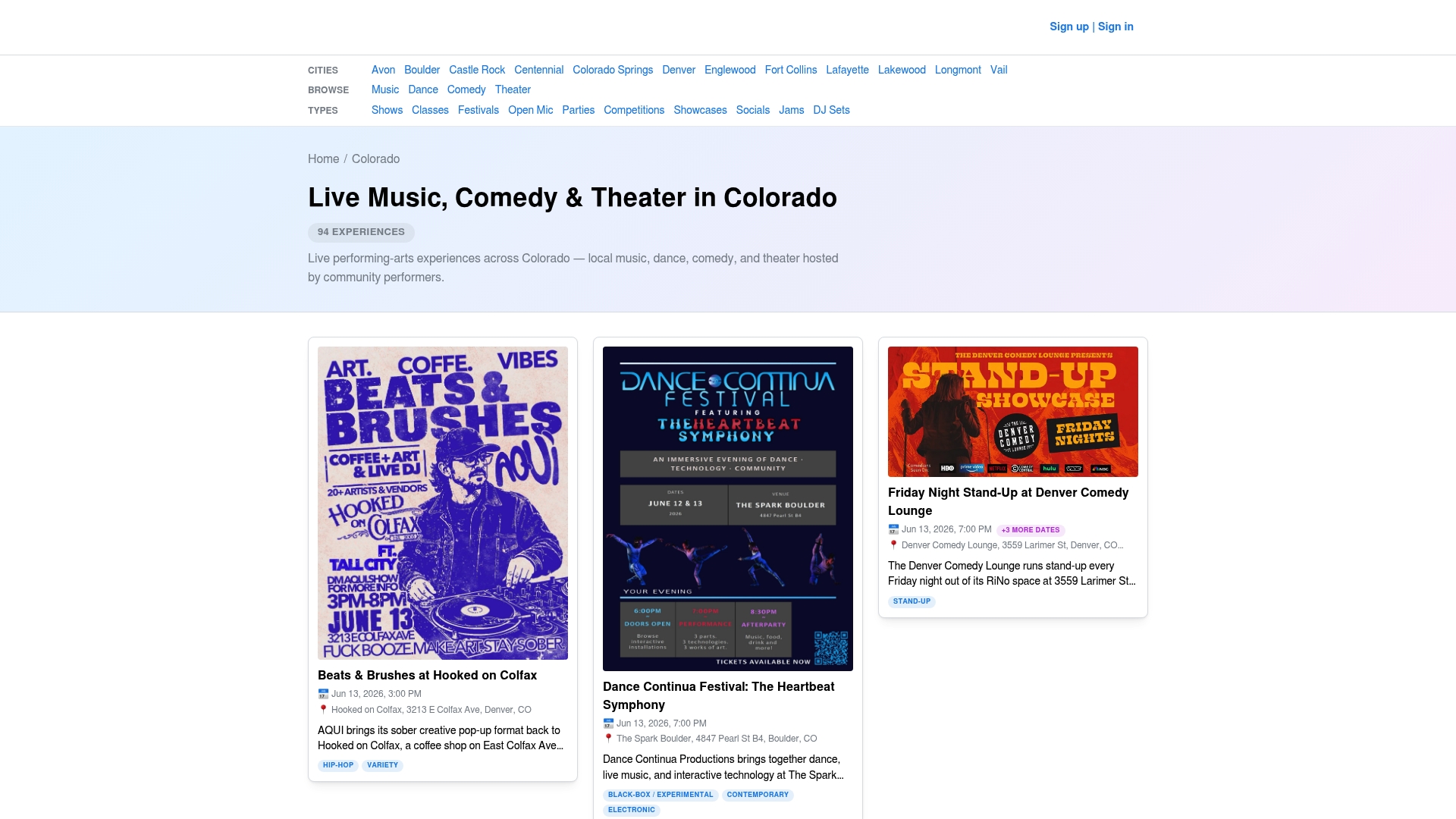
If you're an artist or host with an event, you can list it with us and reach audiences who are looking for exactly this kind of night. Browse everything we have at Experience By Locals.
Our perspective
We love DIY rooms because they remind us why live art matters. Nobody is there for a logo or a lanyard. They're there because someone they know is on stage and someone else opened a door for them.
That is the idea behind Experience By Locals. The best nights in Colorado are usually hosted by community artists and creators, whether that's a punk show, a K-pop choreography session, a comedy night or a theater piece. We think those nights deserve to be easy to find and easy to join.
The reporting on Denver's scene is clear: these spaces survive on volunteers, donations and goodwill. When you discover a show, buy a ticket, bring a friend or tell someone about it, you are helping local talent keep making things.
We'd love to see you at one of them.
DJ
FAQ
Are DIY venues in Denver safe for first-timers?
Most are welcoming, and many are all-ages and sober by design. Rooms like Seventh Circle and Ante Up are run by volunteers who want newcomers to feel at home. Arrive early, note the exits, and ask a volunteer if you're unsure about the house rules.
How much does a show cost?
It depends on the room. Many ask for a suggested donation instead of a fixed price, and Seventh Circle also offers a $5 yearly membership. Some spaces, like The D.M.V., say no one is turned away for lack of funds. Bring cash and give what you can.
How do I find an address for a house show?
House show addresses usually spread by word of mouth and through the bands involved. Go to a few public venue shows, meet people and ask. Public rooms are the best entry point, and our Denver live music listings can point you to local nights.
How can a band get a show at a DIY venue?
Start by attending. Westword reports that bands at this level book through personal connections rather than agents. Introduce yourself, support other acts and then message the organizers about a slot that fits your sound.
Are DIY venues only for punk?
No. Reporting from Rocky Mountain PBS describes noise, hardcore, psych folk, country, drag, comedy and art shows. The common thread is community, not a single genre.
Sources
- What DIY spaces like Denver's Rhinoceropolis and Glob do, Denverite
- 5 Denver Punk Venues Locals Should Know, Westword
- As Denver Transforms, Rhinoceropolis Remains the Heart of the Underground, Westword
- Denver's DIY music scene is reviving as smaller, Rocky Mountain PBS
- New Denver Punk Venue Ante Up Is an All-Ages Community Space, Westword
- Denver's DIY scene is making noise with a new venue, Denverite
- Why DIY Venues Are Vital to the Health of the Entire Music Scene, Westword
- DIY or die: Why Denver needs under-the-radar, all-ages arts spaces, Westword
- Blucifer's First Rodeo, Westword
- Denver DIY Scene Resurfaces Three Years After Ghost Ship Fire, Westword
- NIVA's State of Live Report on Denver's independent stages