
Adult Dance Classes in Colorado: Find Your First Class

The best adult dance class is one you will actually walk into: a room with a teacher who dances for a living in your town, a level that matches where you are today, and a price that lets you try before you commit. On Experience By Locals, you can browse and book dance classes and workshops hosted by Colorado artists, from Boulder to the rest of the state, and pick the one that fits your schedule.
This guide covers the styles you will see, how classes, private lessons and workshops differ, what they typically cost in the US, what to wear, and how to choose well.
TL;DR
- Adult classes come in three broad flavors: social (ballroom, Latin, swing), performance-based (ballet, tap, modern) and fitness-driven (Zumba, belly dance). Pick by the feeling you want, not the label.
- Single drop-in classes typically run $12 to $25 nationally, and class packs bring the per-class price down. Big metros skew 30 to 50% higher.
- You do not need experience. Look for classes labeled intro, beginner or open level.
- Workshops are one-time sessions, a low-pressure way to sample a style before a multi-week series.
- Wear clothes you can move in, arrive 10 to 15 minutes early, and bring water.
Table of Contents
- Which kind of adult dance class fits you?
- Beginner? You belong here
- Classes, private lessons and workshops: what is the difference?
- What adult dance classes cost
- What happens in a first class
- How to pick the right class for you
- Why learn from a local artist?
- Find and book a class on Experience By Locals
- Our perspective
- FAQ
- Sources
Which kind of adult dance class fits you?
Start with what you want out of an hour. The consumer-funded testing organization Checkbook sorts adult dance into three groups, and it is a handy map:
- Social dance: ballroom, country-western, Latin and square dance. You often rotate partners, and the goal is to enjoy dancing with other people at a party, a wedding or a night out.
- Performance styles: ballet, tap and modern. These build technique and body awareness, and many studios let adults take them alongside experienced dancers.
- Recreation and exercise: Zumba and belly dancing, where the workout and the fun come first.
On top of those, you will meet styles that are popular right now with adults: hip hop, jazz, contemporary, heels and K-pop choreography, where you learn a routine move by move. Colorado's local scene also includes aerial dance and modern dance, taught by working artists, which you will rarely find at a big-box fitness club. If you like the idea of learning from the people who also perform on local stages, that is exactly what we list.
A quick way to choose
| If you want... | Look for... |
|---|---|
| A night out with new people | Partner and social dances: swing, salsa, ballroom, country |
| A workout that feels like play | Dance fitness, hip hop, K-pop choreography |
| Grace, strength and technique | Ballet, modern, contemporary, jazz |
| Something nobody else is doing | Aerial dance or a local artist's own style |
| Zero commitment | A single workshop or drop-in |
Beginner? You belong here
The biggest barrier to adult dance is the voice that says everyone else already knows what they are doing. They do not. Adult studios across the country label classes by level so that true first-timers have a place to start, and open-level classes are designed for people with no experience. Introductory or "absolute beginner" labels usually mean you have never taken a formal dance class, and no rhythm, flexibility or background is expected.
A few practical notes:
- Read the level description. Some intermediate and advanced ballet or pointe classes expect a couple of years of training. Open-level and intro classes do not.
- Start with a short series or a workshop if you are brand new to a style. A multi-week intro gives you the vocabulary before you step into an ongoing class.
- You do not need a partner. Partner dance classes typically rotate partners, which is part of the fun and how you learn to adapt to different dancers.
- Expect the early weeks to feel awkward. That is normal. Our guide to common challenges beginner dancers face walks through the usual stumbling blocks and how to move past them.
Classes, private lessons and workshops: what is the difference?
These words get used loosely, so here is how to read them.
Group classes are the standard format: one teacher, a room of students, a set hour. They are usually a series (weekly for several weeks) or drop-in, where you pay per visit. This is the lowest-barrier way in and the best place to meet people.
Private lessons are one-on-one, or one teacher with a partner. You get tailored feedback and flexible scheduling, which is useful if you are preparing for a wedding dance or want to move faster on one skill. Expect a higher price per hour.
Semi-private lessons sit in between: a handful of students sharing a teacher.
Workshops are one-time (or short, intensive) sessions focused on a single style, routine or skill. They tend to be larger and more social, and they let you sample a style without signing up for months. If you have never been to one, our guide to how dance workshops are structured explains the usual flow of the session, and the piece on improving dance skills with local workshops shows how to get the most out of them.

For Boulder readers, there is a dedicated listing of modern dance classes and workshops in Boulder.
What adult dance classes cost
Prices vary by city, style and format, so treat the following as a range to budget against, not a quote. ClassCard's 2025 to 2026 US pricing benchmarks put typical figures at:
| Format | Typical US range |
|---|---|
| Adult drop-in class | $12 to $25 |
| 5-class pack | $50 to $100 |
| 10-class pack | $90 to $180 |
| 60-minute private lesson | $80 to $100 |
| Semi-private lesson, per student | $50 to $70 |
| Workshop session | $25 to $50 |
| Multi-day intensive | $150 to $300 |
The same source notes that major metros such as New York, Los Angeles and Chicago run 30 to 50% higher, and that some studios add extras: annual registration fees of $35 to $65, costume fees of $50 or more, and recital fees of $50 to $150. Those extras mostly apply to studios with a recital season, so ask about them before you pay for a series.
Two money habits help. First, a pack almost always beats paying per class once you know you like a style. Second, Checkbook's advice is to avoid long-term memberships until you have taken part for a few months, and to ask whether a trial lesson is available before paying for a whole series. If you are curious how teachers think about setting those rates, this breakdown of private lesson pricing for studios shows the numbers from the teacher's side.

What happens in a first class
Most beginner classes follow the same arc. You arrive, meet the teacher, warm up, learn a few basic steps, and build on them gradually. In partner dance, you will rotate partners. In a choreography class, you learn a short routine in pieces and run it a few times at the end.
What to bring:
- Comfortable clothes you can stretch and move in. Layers help, because you will warm up fast.
- The right shoes for the style. Clean sneakers work for hip hop and many fitness classes. Ballet needs ballet slippers, and tap needs tap shoes. For smooth-soled partner dances, ask the host whether street shoes are fine.
- Water and a small towel.
- Hair ties and any needed supports so nothing distracts you mid-turn.
Get there 10 to 15 minutes early so you can find the room, change shoes and say hello to the teacher. Tell them about any injury or limitation. Good instructors offer modifications, and Checkbook specifically recommends looking for teachers who adapt movement for injuries or different abilities. If you have a medical condition or a recent injury, check with your doctor before starting a new physical activity.
For a printable-style run-through, use our dance workshop checklist for beginners.
How to pick the right class for you
- Define your goal in one sentence. "I want to move more and meet people" points toward social or fitness classes. "I want to learn real technique" points toward ballet or modern.
- Match the level honestly. If you have never taken a class, choose intro, beginner or open level, even if you are athletic.
- Check the schedule you can keep. A class at a time you can reach weekly beats a perfect class you skip.
- Ask about the teacher. Credentials and years of teaching are fair questions, and so is how they handle mixed levels.
- Try one session first. A single drop-in or workshop tells you more than any description.
- Think about the room. Size, floor, parking and how welcoming the space feels all matter. Venues such as Streetside Dance Studio and Frequent Flyers Aerial Dance Studio have their own pages, so you can see what is on offer.
If accessibility matters to you, message the host before booking. Hosts on our platform run their own classes, so they can tell you directly what a session involves.
Why learn from a local artist?
A chain studio can give you steps. A local artist gives you steps plus context: the style they trained in, the shows they are dancing in this month, the community they are part of. That is the difference between a class and a connection.
It also helps the people making your city's culture. Artists who teach can keep creating, and you may end up watching them perform later. If you like what you learn, our dance performances in Boulder and Fort Collins pages show where to see local dancers on stage, and New Breed Dance Company has its own performer page.
Find and book a class on Experience By Locals
We built Experience By Locals so you can browse Colorado's live music, dance, comedy and theater, plus classes and workshops, and book directly with the people hosting them. Browsing is free, and you pay only when you book an event.
Start with the Colorado dance class listings, or look at the whole Colorado calendar of music, dance, comedy and theater if you want to build a full night out around your first class.
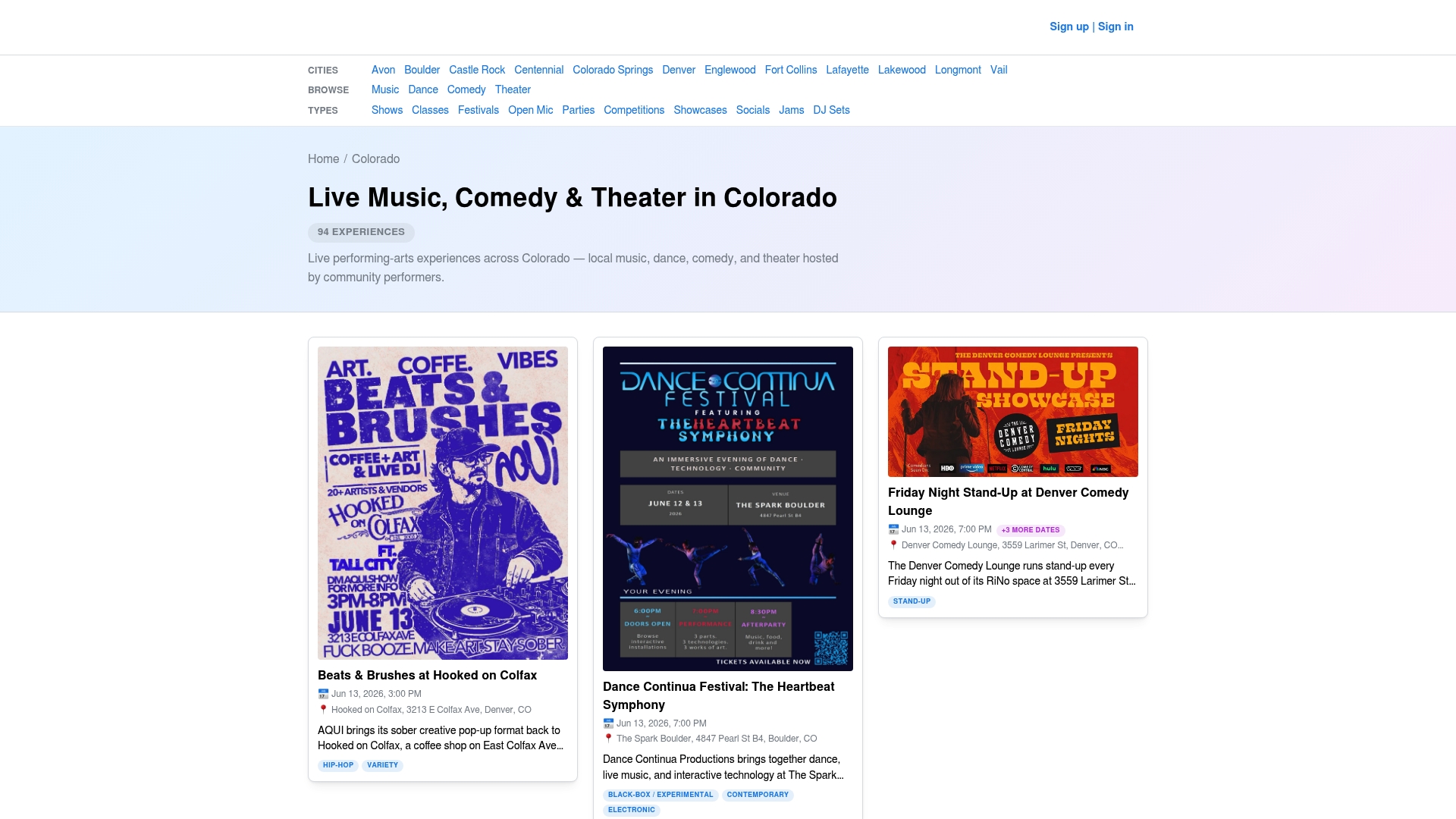
For artists reading this: if you teach or host, listing your class puts it in front of people searching for something real and local. Come join us.
Our perspective
We hear it all the time: "I would love to dance, but I do not know where to start." The honest answer is that the starting point is smaller than people think. It is one hour, one room and one teacher who is happy you showed up.
That is why we focus on local artists. The person leading your class is part of Colorado's creative community, not just a name on a schedule. They know the scene, they know the stages, and they are usually glad to talk about where a first class can lead.
Our advice: choose a style that makes you curious, pick the beginner-friendly option, and go once. Notice how you feel afterward. Then book another, and bring a friend. Dance gets easier, and a lot more fun, when it becomes part of your week. 🤝
DJ
FAQ
Do I need experience to join an adult dance class?
No. Many classes are labeled intro, beginner or open level and are built for people who have never danced. Check the level description, because some intermediate ballet and pointe classes expect prior training.
How much do adult dance classes cost?
Nationally, drop-in classes typically run $12 to $25, with 5-class packs at $50 to $100 and 10-class packs at $90 to $180. Workshops are often $25 to $50 per session. Prices run higher in major metros, so check each listing for the exact amount.
What should I wear to my first class?
Wear clothes you can move in, and shoes that suit the style: clean sneakers for hip hop or fitness, ballet slippers for ballet and tap shoes for tap. Bring water and arrive 10 to 15 minutes early.
Are workshops better than regular classes for beginners?
They serve a different purpose. A workshop is a one-time session, so it is a low-commitment way to sample a style. A regular class series builds skills week by week, so many people try a workshop first and then sign up for a series.
Do I need a partner?
No. Partner dance classes usually rotate partners, so you can come on your own and meet people as you learn.
Sources
- Checkbook: Dance Classes
- ClassCard: How Much to Charge for Dance Classes
- Private lesson pricing for dance studios